Today's
EarthStation1.com 15% (Or More!) Off Commemorative Memorial Title:
Scouts! Lord Baden-Powell The Boy Scouts & The Girl Scouts MP4
DVD USB
Today, August 30, 2026
August 30: National Toasted Marshmallow
Day: -- One of the most anticipated food holidays many look
forward to every year! It not only allows us to enjoy a sweet
treat like toasted marshmallows over a fire, but it also marks one
of the last times people will be enjoying summer. Marshmallows,
believe it or not, have been around for quite a while. In fact,
ancient Egypt made the sugary treat thousands of years ago.
History has also recorded people using it for treating ailments
like angina. Now that's something rather bizarre you don't hear
about every day. Let us take you on a journey of how this beloved
treat came into being and how you can celebrate the day in all its
glory! The National Toasted Marshmallow Day was created by the
National Confectioners Association (NCA). The organization
promotes the sweets businesses in the U.S.A. One may think that
promoting sugary food items might make for an unhealthy nation,
but NCA aims to bring to light the benefits of choosing healthy
options, which would, in turn, lead to a "balanced lifestyle"
for many. Another of NCA's goals includes lobbying for better
communication frameworks, industrial insights, and regulatory
business laws. All these factors would help candy businesses in
America to grow and remain maintained in both the local and global
market spheres. The candy business alone creates some 54,000 job
opportunities in over 1,3000 factories in the country. The exact
date of when marshmallows were created has been lost to history,
but many scholars cite ancient Egypt as somewhat of a starting
point for the sweet treat. Ancient Egyptians made marshmallows by
extracting the sap from the root of a plant called 'Althaea
officinalis.' This plant is native to North Africa, Asia, and
Europe, and it grows, as you may have guessed, in marshes. Apart
from being used to make marshmallows, the plant was also employed
as an ornamental decoration throughout the world. Coming back to
the sweet treat, the marshmallow-making process was extremely
tedious and laborious in nature. The special final product, mixed
with honey and nuts, was served to royalty and gods only, making
it off-limits for the public. Over the centuries, the marshmallow
went through several changes. From being produced by French
confectioners by hand in the 1800s to being produced using
machines in the 1900s, marshmallows were being enjoyed by more and
more people. The key ingredient, which was the root of the
marshmallow plant, was also replaced with gelatin/corn starch as
the latter made the process easier and faster. People eat
marshmallows in a variety of ways. They have it in milkshakes or
with chocolate or crackers or simply toasted. On Sale Until
Midnight Tonight PT!
https://store.earthstation1.com/scouts-the-life-and-legacy-of-lord-badenpowell-dvd-mp4-us4.html
Today's
EarthStation1.com 15% (Or More!) Off Commemorative Memorial Title:
TV Music & Dance Shows #5 Ready Steady Go! DVD, Download,
Flash Drive
Today, August 30, 2026
August 30: National Beach Day: -- An
annual time to spend on beaches at the oceanside, at a lake or at
a river! They provide recreation all summer long - swimming, water
sports, and sunbathing are just a few of the relaxing things that
come to mind. We also enjoy playing Frisbee, volleyball and long
walks. Floating along in the surf on a hot summer day with friends
creates summer memories we remember for years to come. Sometimes,
just packing a few icy beverages and a good book is enough to make
a beach day perfect. However, we are responsible for caring for
the beach, too. Not only should we pack out what we pack in, but
it's necessary to follow the beach rules, also. Safety and fun go
hand in hand. To observe National Beach Day, take some excellent
tips from the American Red Cross: 1. Swim with a lifeguard present
and only in designated areas. 2. Go with a buddy. Never swim
alone. 3. Watch for currents, moving water, and riptides. These
occur in oceans, lakes, and rivers. 4. Swim within your depth.
Don't swim longer than you are physically capable of doing. 5.
Take swimming lessons. 6. Learn CPR. Also, you can organize a
group to clean up your favorite beach. Since it's near the end of
the season, your beach will appreciate it. Find out what the
facility needs. Take up donations for supplies to keep the beach
even cleaner next year. Donate garbage and recycling cans for your
beach. Attend a seminar on water pollution and how to prevent it.
Share pictures of your favorite beach while enjoying the last days
of summer - and use #NationalBeachDay to share on social media
when you do! In 1929, the Knights of Columbus out of Milwaukee,
Wisconsin launched a National Beach Day as part of their
convention plans. However, it never took root. Then in 2014,
Colleen Paige, pet and family lifestyle expert, created National
Beach Day to celebrate beaches and the importance of keeping them
clean. On Sale Until Midnight Tonight PT!
https://store.earthstation1.com/classic-tv-music-amp-dance-shows-5-ready-steady-go-dv5.html
Today's
EarthStation1.com 15% (Or More!) Off Commemorative Memorial Title:
Super Sense Animal Perception/Plant Adaptation TV Series DVD, MP4,
USB
Today, August 30, 2026
August 30: National Holistic Pet Day: --
Mind. Body. Spirit. Fetch! When it comes to the well-being of our
pets, any kind of movement is game - even fetch. Today is a time
to consider all aspects of your pet's health at the same time, not
symptom by symptom. It is also a day when we share valuable
insights to help our pets have more fulfilling lives. A holistic
approach to well-being is nothing new for humans, but applying the
lifestyle to household pets is still a growing trend. It starts
with the basics of good nutrition, lots of physical exercise, and
even mental stimulation. Animals need to be mentally active and
challenged or they risk listlessness and boredom. Take some time
to learn about caring for your pet with the same generosity you
give your own mind, body, and spirit. Holistic medicine has grown
in popularity over recent years but many people will not have
considered it in terms of the way they go about treating their
pets with veterinary care. But just like a variety of aspects of
life, when it comes to pet care, it may be a healthy step to move
toward something that is more natural in scope. Holistic Pet Day
was set up to try and bring more publicity to the idea that
holistic treatments, where a pet's lifestyle, diet and environment
are fully considered, are more beneficial for their temporary
health and also impacting their longevity. Using holistic
treatments is said to improve nutrition, increase a pet's energy
and it may even have the power to cure some chronic conditions
that many pets face. National Holistic Pet Day was started by
Colleen Paige from the Animal Miracle Foundation to encourage
owners to look at all issues that could impact on the welfare of
their pets. Paige has been the catalyst behind a number of days
that are meant to support and raise awareness for pet health and
appreciation. Some of the other days associated with Coleen Paige
include National Puppy Day in March, National Wildlife Day in
September and many other delightful days that are certainly worth
celebrating! On Sale Until Midnight Tonight PT!
https://store.earthstation1.com/super-sense--animal-perception-tv-series-dvd-mp4-download-usb-driv4.html
Today's
EarthStation1.com 15% (Or More!) Off Commemorative Memorial Title:
The Best Of SCTV Network (1988) Best-Of Retrospective DVD, MP4,
USB
Today, August 30, 2026
August 30: Slinky Day: -- A day set aside
to honor a Toy Hall of Fame Superstar that appeared by chance but
captured the imagination of children all around the country.
Richard James, an American naval engineer, designed the Slinky toy
in 1943 in Philadelphia, and it has been around for more than six
decades. In the toy market, it was an instant hit, selling out in
a matter of hours. Slinky Day honors the Slinky by allowing
children to enjoy Slinky stunts, race with Slinkies, or simply
untangle Slinkies as they knot, twist, and spiral! Richard James,
a Navy mechanical engineer, stationed at the time, discovered the
Slinky by knocking a spring off a shelf by accident and watched as
it stepped in a series of arcs to a stack of books, a tabletop,
and finally to the floor, where it recoiled and stood upright.
Over the next year, James experimented with several sorts of steel
wire until he discovered a spring that could walk. The Jameses had
trouble selling Slinky to toy stores, but they were granted
permission to show the toy in November 1945. Slinky was a smash
hit, with the first 400 units selling out in under 90 minutes.
Slinky was first shown at the U.S. Toy Fair in 1946. In 1952, the
Slinky Dog debuted. In the 1950s, new Slinky toys were introduced.
Some of these include slinky Suzie and Slinky Crazy Eyes. After
his wife filed for divorce in 1960, Richard James quit the
company. Betty James ran the company, juggled creditors, and
relocated it to Hollidaysburg, Pennsylvania, in 1964. Betty James
insisted on keeping the original Slinky affordable and a slinky
cost between 1.89 and 2.69 in 1996. Poof Products, Inc. of
Plymouth, Michigan, a manufacturer of foam sports balls, purchased
James Industries in 1998. Poof-Slinky, Inc. was formed in 2003
when James Industries and Poof Products, Inc. amalgamated. Slinky
has been used as a teaching tool, a portable radio antenna, and in
NASA physics experiments, in addition to being a toy. On Sale
Until Midnight Tonight PT!
https://store.earthstation1.com/the-best-of-the-sctv-network-19881988.html
Today's
EarthStation1.com 15% (Or More!) Off Commemorative Memorial Title:
Frankenstein: The Modern Prometheus Documentary MP4 Video Download
DVD
Today, August 30, 2026
August 30: Frankenstein Day: -- Today
we're celebrating with all the details surrounding this classic
novel! Can you believe it's been over 200 years since the original
"Frankenstein" story was published? That's two centuries
since a young scientist named Victor Frankenstein breathed life
into his very own creature - the monster! And led to countless
Halloweens of young children covered in green paint with
box-shaped foreheads. Let's dive into this fun holiday on the date
of the birthday of its brilliant author, Mary Shelley! Published
in 1818, "Frankenstein" is considered one of the most
important science fiction pieces ever written. It tells the tale
of a young scientist named Victor Frankenstein who is fascinated
with the creation of life. He conducts an experiment where, using
a variety of human parts, he is able to bring life to a creature,
which would later be known as 'the monster.' The story then
follows Victor and the monster's tumultuous connection, as both
seek the secret to peace and happiness. The novel received mixed
reviews at the time of publication. As a female writer, Mary
Shelly faced challenges in gaining acceptance and reverence from
some of her male counterparts. But as time passed, especially
since the mid-20th century, "Frankenstein" has received
generally positive reviews. It is widely considered one of the
seminal works in gothic, science-fiction, and romantic literature.
Almost as soon as it was published, "Frankenstein"
quickly lent itself to a variety of mediums. Theatres and opera
houses would put on fantastic shows and musicals based on the
scientist and his creature. As film and television grew in
prominence throughout the 1900s, the number of "Frankenstein"
adaptations multiplied. Two iconic additions of Frankenstein lore
came in the 1930s, with the movies "Bride of Frankenstein"
and its sequel "Son of Frankenstein." While some stories
would stick more closely to Mary Shelly's source material, others
would take a more liberal approach, adding new layers to the
Frankenstein world, including time travel, superhuman abilities,
and world domination. On Sale Until Midnight Tonight PT!
https://store.earthstation1.com/frankenstein-the-modern-prometheus-documentary-mp4-video-download-dv4.html
Today's
EarthStation1.com 15% (Or More!) Off Commemorative Memorial Title:
The Search For The Disappeared Of Argentina DVD, MP4, USB Drive
Today, August 30, 2026
August 30: International Day Of The
Victims Of Enforced Disappearance: -- This day is used to raise
awareness about the global number of enforced disappearances.
Enforced disappearance has been used to spread a sense of dread
throughout society on several occasions. The sense of uncertainty
engendered by this practice is felt not just by close family
members, but also by their communities. Enforced disappearance has
evolved into a global issue that is not limited to a single
location. Also, certain groups of people are more vulnerable to
this unfortunate predicament. International Day of the Victims of
Enforced Disappearances was inspired by the Latin American
Federation of Associations for Relatives of Detained-Disappeared
(F.E.D.E.F.A.M.), a non-governmental organization founded in Costa
Rica in 1981. The organization was active in combating secret
imprisonment, forced disappearances, and abduction in several
Latin American countries. On the International Day of the
Disappeared, August 30, 2007, hundreds of Filipino relatives and
allies of the disappeared demonstrated against the government in
large numbers. Edita Burgos was one of them, recalling her missing
son, Jonas, a member of the Philippines' Peasants' Movement. On
August 30, 2008, the International Coalition against Enforced
Disappearances, a global alliance of family members and human
rights organizations, joined forces in a combined action for a
global campaign to promote the ratification of the International
Convention for the Protection of All Persons from Enforced
Disappearance. Detainment under dubious circumstances is
considered a human rights violation, and the General Assembly of
the United Nations adopted a Declaration on the Protection of all
Persons from Enforced Disappearance as a resolution in December
1992. The United Nations raised concern in 2010 about the rising
incidence of involuntary disappearances around the world, as
hundreds of thousands of people have disappeared in at least 85
nations around the world during hostilities or periods of tyranny.
The U.N. recognized August 30 as an annual event to mark the
International Day of the Victims of Enforced Disappearance during
the International Convention for the Protection of All Persons
from Enforced Disappearances in 2011. On Sale Until Midnight
Tonight PT!
https://store.earthstation1.com/the-search-for-the-disappeared-of-argentina-dvd-mp4-us4.html
Today's
EarthStation1.com 15% (Or More!) Off Commemorative Memorial Title:
Let There Be Light 1946 John Huston + Soldier's Heart MP4 Download
DVD
Today, August 30, 2026
August 30: National Grief Awareness Day:
-- Dedicated to raising awareness of the myriad ways in which
individuals cope with loss. It offers resources to those going
through personal losses and reminds us to support people we know
who are grieving. National Grief Awareness Day, founded by Angie
Cartwright in 2014, hopes to encourage open communication on loss
and bereavement and better inform the public on the facts of
grief. Grief is one of the oldest and most enduring aspects of the
human experience. If you haven't yet experienced grief, it's
unfortunately likely to happen. The term 'grief' encompasses all
of the emotions around a loss, and 'mourning' is defined as the
external expression of the pain. 'Bereavement' is another
commonly-used term for grief. Throughout human history, there have
been many attempts to describe and heal grief, and they have
changed significantly over the years. Due in part to our vastly
improved physical and mental healthcare, grief is understood far
differently today than even as little as 100 years ago. While we
often have the privilege (for some, even the expectation) of only
losing our loved ones when they are at a ripe old age,
comfortable, and with family nearby, this has rarely been the case
throughout history. The lack of modern transportation often
separated loved ones, wars ravaged populations, and poor medical
and sanitation knowledge led to too many untimely deaths.
Throughout history, the deaths of loved ones have been far more
common, and grief was understood differently. Burials, often in
family groupings, occur throughout the world. In many cultures,
family and friends attend funerals or certain types of wakes to
honor the deceased. Though mourning traditions vary from culture
to culture, these aspects of the ritual often persist. In part due
to the frequency of death and grief, the topic was poorly
researched or treated until the 1900s. In 1917, famous
psychologist Sigmund Freud wrote: "grieving is a natural
process that should not be tampered with." This encapsulates
the sentiment well: grieving is a part of life and needs no
special attention. As the century wore on, however, there came to
be more interest in grief and its stages. Elisabeth Kubler-Ross
famously wrote her consequential book, "On Death and Dying,"
in 1969. The book laid out the 'Five Stages of Grief' that many
are familiar with today, under the name 'The Kubler-Ross Method.'
This was easily accepted, and grief was managed along a distinct
timeline for years. Simon Shimshon Rubin put forth the Two Track
Model of Bereavement to further explain the phenomenon in 1981.
However, it was only from 1996 to 2006 that great headway was made
in the understanding of grief as something that resisted strict
and chronological definition. In the 2000s, a more fluid
understanding of grief, especially as a multifaceted and complex
issue, has come to be understood and treated. On Sale Until
Midnight Tonight PT!
https://store.earthstation1.com/let-there-be-light-1946-dvd-john-huston-wwii-psychi1946.html
Today's
EarthStation1.com 15% (Or More!) Off Commemorative Memorial Title:
Heaven Man Earth: Kowloon Walled City The Hong Kong Triads DVD MP4
USB
Today, August 30, 2026
August 30: Liberation Day (Hong Kong,
United Kingdom): -- August 30, 1945: China: The History Of China:
The Century Of Humiliation (The Hundred Years Of National
Humiliation) (1838-1945): The Sino-Japanese Wars: World War II:
The Asia-Pacific War: The Second Sino-Japanese War (The War Of
Resistance Against Japanese Aggression): Hong Kong: The History Of
Hong Kong: British Colonization Of China: The Japanese Occupation
Of Hong Kong: -- Hong Kong is handed over to the British Royal
Navy by the Imperial Japanese Army, restoring British control over
the area, ending The Japanese Occupation Of Hong Kong. August 30
was declared "Liberation Day", and was celebrated as a
public holiday in Hong Kong until 1997, when the Chinese Communist
government callously ended it. General Takashi Sakai, who led the
invasion of Hong Kong and subsequently served as governor-general
during the Japanese occupation, was tried as a war criminal,
convicted and executed on the afternoon of September 30, 1946. On
Sale Until Midnight Tonight PT!
https://store.earthstation1.com/heaven-man-earth-the-organized-crime-of-the-chinese-triads-dvd.html
Today's
EarthStation1.com 15% (Or More!) Off Commemorative Memorial Title:
The Temple In Jerusalem & The Ark Of The Covenant MP4 Download
DVD
Today, August 30, 2026
August 30, 70 AD: Jerusalem: The History Of Jerusalem: Religion: The History Of Religion: Abrahamic Religions: Judaism: The History Of Judaism: The History Of Israel: Judaea: The History Of Judaea: The Jewish-Roman Wars: The First Jewish-Roman War (The Great Jewish Revolt (Hebrew: Ha-Mered Ha-Gadol), The Jewish War): Sieges Of Jerusalem: The Siege Of Jerusalem (70 CE) (Sieges Of Jerusalem: The Siege Of Jerusalem): The Second Temple Herod's Temple): The Destruction Of The Second Temple: -- The destruction of The Second Temple occurs, later known as Herod's Temple, the reconstructed Temple in Jerusalem between c. 516 BCE and 70 CE, when began on August 4, is completed by Roman legions under Titus, son of the Roman Emperor Vespasian, who retook and destroyed much of Jerusalem and the Second Temple on the 9th day of the Hebrew calendar month of Av, the day on which Tisha B'Av is observed, an annual fast day in Judaism on which a number of disasters in Jewish history occurred, primarily the destruction of both Solomon's Temple by the Neo-Babylonian Empire and the Second Temple by the Roman Empire in Jerusalem. By September 8, the city would be fully conquered. On July 20, AD 70, Titus and his legions stormed the Fortress Of Antonia, a citadel built by Herod the Great and named for Herod's patron Mark Antony as a fortress whose chief function was to protect the Second Temple, the eastern end of the so-called Second Wall at the north-western corner of the Temple Mount; in response, the Zealots draw the Roman army into street fights. Titus began his siege a few days before Passover, on 14 Xanthicus (April), surrounding the city with three legions (V Macedonica, XII Fulminata, XV Apollinaris) on the western side and a fourth (X Fretensis) on the Mount of Olives, to the east. If the reference in his Jewish War at 6:421 is to Titus's siege, though difficulties exist with its interpretation, then at the time, according to Josephus, Jerusalem was thronged with many people who had come to celebrate Passover. The thrust of the siege began in the west at the Third Wall, north of the Jaffa Gate. By May, this was breached and the Second Wall also was taken shortly afterwards, leaving the defenders in possession of the Temple and the upper and lower city. The Jewish defenders were split into factions. Simon Bar Giora and John of Giscala, the two prominent Zealot leaders, placed all blame for the failure of the revolt on the shoulders of the moderate leadership. John of Gischala's group murdered another faction leader, Eleazar ben Simon, whose men were entrenched in the forecourts of the Temple. The Zealots resolved to prevent the city from falling into Roman hands by all means necessary, including the murder of political opponents and anyone standing in their way. There were still those wishing to negotiate with the Romans and bring a peaceful end to the siege. The most prominent of these was Yohanan ben Zakkai, whose students smuggled him out of the city in a coffin in order to deal with Vespasian. This, however, was insufficient to deal with the madness that had now gripped the Zealot leadership in Jerusalem and the reign of terror it unleashed upon the population of the city. Josephus describes various acts of savagery committed against the people by its own leadership, including the torching of the city's food supply in an apparent bid to force the defenders to fight for their lives. The enmities between John of Gischala and Simon bar Giora were papered over only when the Roman siege engineers began to erect ramparts. Titus then had a wall built to girdle the city in order to starve out the population more effectively. After several failed attempts to breach or scale the walls of the Fortress of Antonia, the Romans finally launched a secret attack. Despite early successes in repelling the Roman sieges, the Zealots fought amongst themselves, and they lacked proper leadership, resulting in poor discipline, training, and preparation for the battles that were to follow. At one point they destroyed the food stocks in the city, a drastic measure thought to have been undertaken perhaps in order to enlist a merciful God's intervention on behalf of the besieged Jews, or as a stratagem to make the defenders more desperate, supposing that was necessary in order to repel the Roman army. According to Josephus, when the Romans reached Antonia they tried to destroy the wall which protected it. They removed four stones only, but during the night the wall collapsed. "That night the wall was so shaken by the battering rams in that place where John had used his stratagem before, and had undermined their banks, that the ground then gave way, and the wall fell down suddenly." Following this, Titus had raised banks beside the court of the Temple: on the north-west corner, on the north side, and on the west side. Josephus goes on to say that the Jews then attacked the Romans on the east, near the Mount of Olives, but Titus drove them back to the valley. Zealots set the north-west colonnade on fire. The Romans set the next one on fire, and the Jews wanted it to burn, and they also trapped some Roman soldiers when they wanted to climb over the wall. They had burned wood under the wall when Romans were trapped on it. After Jewish allies killed a number of Roman soldiers, Josephus claims that Titus sent him to negotiate with the defenders; this ended with Jews wounding the negotiator Josephus with an arrow, and another sally was launched shortly after. Titus was almost captured during this sudden attack, but escaped. Overlooking the Temple compound, the fortress provided a perfect point from which to attack the Temple itself. Battering rams made little progress, but the fighting itself eventually set the walls on fire. The Siege Of Jerusalem in the year 70 CE was the decisive event of the First Jewish-Roman War. The Roman army, led by the future Emperor Titus, with Tiberius Julius Alexander as his second-in-command, besieged and conquered the city of Jerusalem, which had been controlled by Judean rebel factions since 66 CE, following the Jerusalem riots of 66, when the Judean Free Government was formed in Jerusalem. The siege ended on August 30, 70 CE with the final burning and destruction of what whas left of the Second Temple, and the Romans entered and sacked the Lower City. The destruction of both the first and second temples is still mourned annually as the Jewish fast Tisha B'Av. The Arch of Titus, celebrating the Roman sack of Jerusalem and the Temple, still stands in Rome. The conquest of the city was complete on September 8, 70 CE. On Sale Until Midnight Tonight PT! https://store.earthstation1.com/teinjearkofc.html
Today's
EarthStation1.com 15% (Or More!) Off Commemorative Memorial Title:
The Genius That Was China Documentary Series DVD, Download, USB
Drive
Today, August 30, 2026
August 30, 1363: Greatest Naval Battles:
The Mongols: The Mongol Empire: The Royal House Of Borjigin: The
Chinese Dynasties (The Dynasties Of China, The Chinese Monarchy):
The Yuan Dynasty (Chinese: Yuanchao) (The Great Yuan): The Red
Turban Rebellions (Chinese: Hongjin Qiyi): The Battle Of Lake
Poyang (Chinese: Poyang Hu Zhizhan): -- The largest naval battle
in history in terms of personnel begins, the five-week Battle Of
Lake Poyang (August 30-October 4, 1363), in which the forces of
two Chinese rebel leaders, Chen Youliang and Zhu Yuanzhang, meet
to decide who will supplant the Yuan dynasty during the Red Turban
Rebellions, uprisings against the Yuan Dynasty that had been
established in 1351 by the Mongol leader of Borjigin clan Kublai
Khan, eventually leading to the overthrow of Mongol rule in China
which led to the fall of the Yuan dynasty in 1368 and
establishment of Zhu Yuanzhang as the first Emperor of the Ming
Dynasty as Hongwu. A reported 850,000 sailors and soldiers
involved; a rebel force of Ming (a han people of the Yellow River
Basin), said to be 200,000 strong, commanded by Zhu Yuanzhang, met
a rebel force of Chen Han (a middle Yangtze dynasty), claimed to
be 650,000-strong, commanded by the Chen Han Dynasty founder Chen
Youliang. Chen Youliang besieged Nanchang, the capital and largest
city of Jiangxi Province, with a large fleet on Lake Poyang, the
largest freshwater lake in China, and Zhu Yuanzhang met his force
with a smaller fleet. After an inconclusive engagement exchanging
fire, Zhu employed fire ships to burn and destroy the Han fleet of
Louchuan ships, tower ships central to Han fleets used as floating
fortresses, equipped for boarding and attacking enemy vessels and
with siege weapons such as traction trebuchets, a type of catapult
that uses a long arm to throw a projectile, for ranged combat.
This was the last major battle of the rebellion prior to the rise
of the Ming dynasty. On August 30 , the forces of Chen Han
conducted a major amphibious assault on Nanchang with a hundred
vessels and several hundred troops. The town of Nanchang was
strategically located to guard Lake Poyang, which connected the
Yangtze River with other river basins via the Gan, Xin, and Xiu
rivers. During the early 1360s Zhu Yuanzhang held key garrisons on
the lake and administered them from Nanjing 560 kilometers
downriver. Chen Youliang tried to deposit his troops on the city
walls with "tower ships". This proved futile as the city
defenders simply moved the walls back and Chen was forced to
personally lead an assault on the city gates. They were repelled
with a barrage of cannonfire and driven back. After this failure,
Chen set up a blockade, determined to starve out the defenders,
but a small fishing boat managed to slip out and reached Nanjing
in time to warn Zhu Yuanzhang. Zhu Yuanzhang's fleet arrived at
Poyang Lake on August 29 with a force only a third the size of
Chen's army. According to one Ming source, Zhu's forces arrived
armed with "fire bombs, fire guns, fire arrows, fire seeds
[probably grenades], large and small fire lances, large and small
'commander' fire-tubes, large and small iron bombs, rockets."
This shows that older gunpowder weapons co-existed alongside guns,
and proto-guns such as fire lances were not supplanted until after
early Ming. A new weapon called the "No Alternative" was
also mentioned. The No Alternative was "made from a circular
reed mat about five inches around and seven feet long that was
pasted over with red paper and bound together with silk and hemp-
stuffed inside it was gunpowder twisted in with bullets and all
kinds of [subsidiary] gunpowder weapons." It was hung from a
pole on the foremast, and when an enemy ship came into close
range, the fuse was lit, and the weapon would supposedly fall onto
the enemy ship, at which point things inside shot out "and
burned everything to bits, with no hope of salvation." On
August 30, Zhu's fleet engaged Chen's under orders to "get
close to the enemy's ships and first set off gunpowder weapons
(???), then bows and crossbows, and finally attack their ships
with short range weapons." Fire bombs were hurled using naval
trebuchets and the Ming succeeded in "burning twenty or more
enemy vessels and killing or drowning many enemy troops," but
their own flagship also caught fire and hit a sandbar, forcing
them to withdraw. On August 31, the Ming rammed the enemy fleet
with fire ships. While guns were used during the battle,
ultimately they were not pivotal to success, and the battle was
won using incendiary weapons. On September 2, the two fleets
engaged in battle again, but the tide turned on Chen's forces, and
they were forced to withdraw. Afterwards, Zhu's fleet settled into
a blockade for another month until they employed fire ships again
on October 4, destroying the rest of Chen's fleet. Chen Youliang
was killed when an arrow struck his head. Chen Youliang was
succeeded by his son, Chen Li, who surrendered to Zhu in 1364. The
Ming victory here cemented their position as the leading rebel
group. Five years later, the Ming would overthrow the Yuan and
take command over China. Zhu Yuanzhang then became the first
Emperor of the Ming Dynasty as Hongwu. On Sale Until Midnight
Tonight PT!
https://store.earthstation1.com/the-genius-that-was-china-dvd-tv-documentary-series-2-disc-se2.html
Today's
EarthStation1.com 15% (Or More!) Off Commemorative Memorial Title:
The Guns Of August (1964) WWI Film DVD, Video Download, USB Drive
Today, August 30, 2026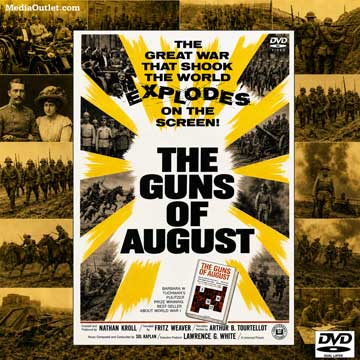
August 30, 1914: The European Civil War:
World War I: The First European War (The European Theater Of World
War I): The Guns Of August: The Eastern Front Of World War I: The
Russian Invasion Of East Prussia (1914): The Battle Of Tannenberg:
-- The Germans defeat the Russians as they almost completely
destroy the Russian Second Army, a catastrophic defeat that
results in the suicide of its commanding general, Alexander
Samsonov. A series of follow-up battles (First Masurian Lakes)
destroyed most of the First Army as well and kept the Russians off
balance until the spring of 1915. The battle is particularly
notable for fast rail movements by the Germans, enabling them to
concentrate against each of the two Russian armies in turn, and
also for the failure of the Russians to encode their radio
messages. It brought high prestige to Field Marshal Paul von
Hindenburg and his rising staff-officer Erich Ludendorff, a pair
who would rise in power until assuming supreme command of Germany
in 1916 for the rest of the war. Although the battle actually took
place near Allenstein (Olsztyn), Hindenburg named it after
Tannenberg, 30 km to the west, in order to, in German eyes, avenge
the defeat of the Teutonic Knights 500 years earlier at the Battle
of Grunwald (which was always known as the Battle Of Tannenberg in
German). On Sale Until Midnight Tonight PT!
https://store.earthstation1.com/the-guns-of-august-dvd-1964-world-war-i-movie-documen1964.html
Today's
EarthStation1.com 15% (Or More!) Off Commemorative Memorial Title:
Heroes Medal Of Honor Victoria Cross Legion Of Honour DVD MP4 USB
Drive
Today, August 30, 2026
August 30, 1891: #BOTD: #HBD! Henry
Tandey, British recipient of the Victoria Cross (VC), the second
most highly decorated British private of the First World War, most
commonly remembered as the soldier who allegedly spared Adolf
Hitler's life during the war (d. December 20, 1977) is #born Henry
James Tandy; he later changed his surname from Tandy to Tandey
after personal problems with his father,and because of this, some
military records have a different spelling of his name. Although
disputed, Adolf Hitler's life was allegedly spared during this
battle by Private Henry James Tandey VC, DCM, MM when they
allegedly encountered each other at the French village of Marcoing
while Tandey was serving with the 5th Duke Of Wellington's
Regiment. According to this account, a weary German soldier
wandered into Tandey's line of fire. The enemy was wounded and did
not appear to have a weapon. Tandey chose not to shoot. The German
soldier saw him lower his rifle and nodded his thanks before
wandering off. That soldier is purported to have been Adolf
Hitler. The author David Johnson, who wrote a book on Henry
Tandey, believes this story was an urban legend. In some versions
of the story, Hitler allegedly saw a newspaper report about Tandey
being awarded the VC (in October 1918, whilst serving with the 5th
Battalion Duke of Wellington's (West Riding) Regiment), recognised
him, and clipped the article. In 1940, during the Coventry Blitz,
Tandey's home was bombed by the Luftwaffe. A journalist approached
him outside his bombed Coventry home, asking him about his alleged
encounter with Hitler. "If only I had known what he would
turn out to be," Tandey is quoted as saying. "When I saw
all the people and women and children he had killed and wounded I
was sorry to God I let him go." Henry Tandey died of
unspecified causes in Coventry, West Midlands, England at the age
of 86. At his request, he was cremated and his ashes buried in the
Masnieres British Cemetery at Marcoing, France, on May 23, 1978,
by his undertaker Pargetter and Son. Due to French laws it was not
permissible for his ashes to be scattered, or any form of ceremony
or commemoration made to him. Henry Tandey Court, on Union Road in
his hometown of Leamington Spa, Warwickshire, England is named
after him. A blue plaque is installed outside the Angel Hotel on
Regent Street where Henry Tandey was born, as well as at St
Peter's School, Augusta Place, Leamington. On Sale Until Midnight
Tonight PT!
https://store.earthstation1.com/heroes-dvd-set-all-26-tv-shows-7-di267.html
Today's
EarthStation1.com 15% (Or More!) Off Commemorative Memorial Title:
American Caesar: Douglas MacArthur TV Series DVD, Download, USB
Drive
Today, August 30, 2026
August 30, 1945: The Aftermath Of World
War II: The End Of World War II In Asia: World War II: The Pacific
War (The Asia-Pacific War, The Asiatic-Pacific Theater, The
Pacific Theater Of World War II): The Pacific War (The
Asia-Pacific War, The Asiatic-Pacific Theater, The Pacific Theater
Of World War II): The Occupation Of Japan (Japanese: Senryo-Ka No
Nihon): -- The Supreme Commander Of The Allied Forces General
Douglas MacArthur lands at Atsugi Air Force Base to begin command
of the military occupation of Japan as Military Governor. The day
before, MacArthur was ordered to exercise authority through the
Japanese government machinery, including the Emperor Hirohito.
MacArthur's headquarters was located in the Dai Ichi Life
Insurance Building (DN Tower 21) in Tokyo. The Government of Tokyo
designated DN Tower 21 as a historical building in 2004. Unlike in
Germany, where the Allies had in May 1945 abolished the German
state, the Americans chose to allow the Japanese state to continue
to exist, albeit under their ultimate control. Unlike Germany,
there was a certain partnership between the occupiers and occupied
as MacArthur decided to rule Japan via the Emperor and most of the
rest of the Japanese elite. The Emperor was a living god to the
Japanese people, and MacArthur found that ruling via the Emperor
made his job in running Japan much easier than it otherwise would
have been. MacArthur took the view that a few "militarist"
extremists had "hijacked" Japan starting in 1931 with
the Mukden Incident, an event staged by Japanese military
personnel as a pretext for the Japanese invasion in 1931 of
northeastern China, known as Manchuria. MacArthur saw the Emperor
was a pro-Western "moderate" who had been powerless to
stop the militarists, and thus bore no responsibility for any of
the war crimes committed by the Japanese between 1931 and 1945. At
the same time, MacArthur undermined the imperial mystique when his
staff released the famous picture of his first meeting with the
Emperor, the impact of which on the Japanese public was electric
as the Japanese people for the first time saw the Emperor as a
mere man overshadowed by the much taller MacArthur instead of the
living god he had always been portrayed as. Up to 1945, the
Emperor had been a remote, mysterious figure to his people, rarely
seen in public and always silent, whose photographs were always
taken from a certain angle to make him look taller and more
impressive than he really was. No Japanese photographer would have
taken such a photo of the Emperor being overshadowed by MacArthur.
The Japanese government immediately banned the photo of the
Emperor with MacArthur on the grounds that it damaged the imperial
mystique, but MacArthur rescinded the ban and ordered all of the
Japanese newspapers to print it. The photo was intended as a
message to the Emperor about who was going to be the senior
partner in their relationship. As he needed the Emperor, MacArthur
protected him from any effort to hold accountable for his actions,
and allowed him to issue statements that incorrectly portrayed the
emerging democratic post-war era as a continuation of the Meiji
era reforms. MacArthur did not allow any investigations of the
Emperor, and instead in October 1945 ordered his staff "in
the interests of peaceful occupation and rehabilitation of Japan,
prevention of revolution and communism, all facts surrounding the
execution of the declaration of war and subsequent position of the
Emperor which tend to show fraud, menace or duress be marshalled".
In January 1946, MacArthur reported to Washington that the Emperor
could not be indicted for war crimes on the grounds: "His
indictment will unquestionably cause a tremendous convulsion among
the Japanese people, the repercussions of which cannot be
overestimated. He is a symbol which unites all Japanese. Destroy
him and the nation will disintegrate...It is quite possible that a
million troops would be required which would have to be maintained
for an indefinite number of years. To protect the Emperor from
being indicted, MacArthur had one of his staff, Brigadier General
Bonner Fellers tell the genro Admiral Mitsumasa Yonai on 6 March
1946: "To counter this situation, it would be most convenient
if the Japanese side could prove to us that the Emperor is
completely blameless. I think the forthcoming trials offer the
best opportunity to do that. Tojo, in particular should be made to
bear all responsibility at his trial. I want you to have Tojo say
as follows: "At the imperial conference prior to the start of
the war, I already decided to push for war even if his majesty the
emperor was against going to war with the United States."
From the viewpoint of both sides, having one especially evil
figure in the form of General Hideki Tojo, on whom everything that
went wrong could be blamed, was most politically convenient. At a
second meeting on 22 March 1946, Fellers told Admiral Yonai as
recorded by his interpreter Mizota Shuichi: "The most
influential advocate of un-American thought in the United States
is Cohen (a Jew and a Communist), the top adviser to Secretary Of
State Byrnes. As I told Yonai... it is extremely disadvantageous
to MacArthur's standing in the United States to put on trial the
very Emperor who is cooperating with him and facilitating the
smooth administration of the occupation. This is the reason for my
request... "I wonder whether what I said to Admiral Yonai the
other day has already been conveyed to Tojo?". MacArthur's
attempts to shield the Emperor from indictment and to have all the
blame taken by General Tojo were successful. On Sale Until
Midnight Tonight PT!
https://store.earthstation1.com/american-caesar-douglas-macarthur-tv-series-3-dvds-john-husto3.html
Today's
EarthStation1.com 15% (Or More!) Off Commemorative Memorial Title:
Simple Justice Brown v Board Of Education Docudrama DVD, Download,
USB
Today, August 30, 2026
August 30, 1966: Civil Rights Movements:
The American Civil Rights Movement (1954-1968): African American
District Court Justices: -- Constance Baker Motley becomes the
first African American female federal judge when she takes the
seat on the United States District Court for the Southern District
of New York vacated by Judge Archie Owen Dawson. President Lyndon
B. Johnson nominated Motley to the position on January 26, 1966,
but segregationist Senator James Eastland of Mississippi delayed
her confirmation process for seven months. Eastland was in
opposition to her past desegregation work including Brown v. Board
of Education and Meredith v. Fair. He used his influence as chair
of the Senate Judiciary Committee to disrupt Motley's nomination,
and went as far as accusing her of being a member of the Communist
Party. Despite opposition, she was confirmed by the United States
Senate on August 30, 1966, and received her commission the same
day, becoming the first African American female federal judge. She
served as Chief Judge from 1982 to 1986. She assumed senior status
on September 30, 1986. Her service terminated on September 28,
2005, due to her death in New York City. Constance Baker Motley
(nee Baker; September 14, 1921 - September 28, 2005) was an
American jurist and politician, who served as a Judge of the
United States District Court for the Southern District of New
York. A key strategist of the civil rights movement, she was state
senator, and Borough President of Manhattan in New York City
before becoming a United States federal judge. She obtained a role
with the NAACP Legal Defense and Educational Fund as a staff
attorney in 1946 after receiving her law degree, and continued her
work with the organization for more than twenty years. She was the
first Black woman to argue at the Supreme Court and argued 10
landmark civil rights cases, winning nine. She was a law clerk to
Thurgood Marshall, aiding him in the case Brown v. Board of
Education. Motley was also the first African-American woman
appointed to the federal judiciary, serving as a United States
district judge of the United States District Court for the
Southern District of New York. In 1965, Motley was elected
President of the Borough of Manhattan to fill a one-year vacancy.
She was the first woman to hold the office. As president, she
authored a revitalization plan for Harlem and East Harlem,
successfully fighting for 700K USD to improve these and other
underserved areas of the city. On Sale Until Midnight Tonight PT!
https://store.earthstation1.com/simple-justice-brown-v-board-of-education-segregation-battle-dvd.html
Today's
EarthStation1.com 15% (Or More!) Off Commemorative Memorial Title:
The Road To Brown: Battle Against Plessy v Ferguson DVD Download
USB
Today, August 30, 2026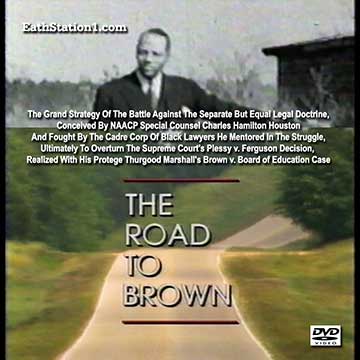
August 30, 1967: Civil Rights Movements:
The American Civil Rights Movement (1954-1968): African American
Justices Of The Supreme Court: -- Thurgood Marshall is confirmed
as the first African American Justice of the Supreme Court Of The
United States. On June 13, 1967, U.S. President Lyndon B. Johnson
nominated Solicitor-General Thurgood Marshall to the U.S. Supreme
Court. Thurgood Marshall (July 2, 1908 - January 24, 1993) was an
American lawyer and Freemason, serving as Associate Justice of the
Supreme Court Of The United States from October 1967 until October
1991. Marshall was the Court's 96th justice and its first African
American justice. Prior to his judicial service, he successfully
argued several cases before the Supreme Court. Born in Baltimore,
Maryland, Marshall graduated from the Howard University School of
Law in 1933. He established a private legal practice in Baltimore
before founding the NAACP Legal Defense and Educational Fund,
where he served as executive director. In that position, he argued
several cases before the Supreme Court, including Smith v.
Allwright, Shelley v. Kraemer, and Brown v. Board of Education,
which held that racial segregation in public education is a
violation of the Equal Protection Clause. In 1961, President John
F. Kennedy appointed Marshall to United States Court of Appeals
for the Second Circuit. Four years later, President Lyndon B.
Johnson appointed Marshall as the United States Solicitor General.
In 1967, Johnson successfully nominated Marshall to succeed
retiring Associate Justice Tom C. Clark. Marshall retired during
the administration of President George H. W. Bush, and was
succeeded by Clarence Thomas. On Sale Until Midnight Tonight PT!
https://store.earthstation1.com/the-road-to-brown-battle-against-plessy-v-ferguson-dvd-download-usb.html
Today's
EarthStation1.com 15% (Or More!) Off Commemorative Memorial Title:
Black Stars In Orbit: The Black Astronauts Of NASA MP4 Download Or
DVD
Today, August 30, 2026
August 30, 1983: Rocket Launches: The
History Of Rocketry: The History Of Spaceflight: The Aftermath Of
World War II: The Cold War: The Space Age: The Space Race: Space
Programs Of The United States: Human Spaceflight Programs: The
Space Shuttle Program (The Space Transportation System (STS)):
STS-8: -- Guion Bluford becomes the first black astronaut when he
flies aboard NASA's Space Shuttle Challenger when it launches from
Kennedy Space Center Launch Complex 39A (LC-39A) on the STS-8
Space Shuttle mission to conduct the first night launch and, on
September 5, 1983, the first night landing of the Space Shuttle
program. It was crewed by Daniel Brandenstein, Pilot; Richard
Truly, Commander; Guion Bluford, Mission Specialist; Dale Gardner,
Mission Specialist; and William E. Thornton, Mission Specialist.
STS-8 was the eighth NASA Space Shuttle mission and the third
flight of the Space Shuttle Challenger. The mission successfully
achieved all of its planned research objectives, but was marred by
the subsequent discovery that a solid-fuel rocket booster had
almost malfunctioned catastrophically during the launch. The
mission's primary payload was INSAT-1B, an Indian communications
and weather observation satellite, which was released by the
orbiter and boosted into a geostationary orbit. The secondary
payload, replacing a delayed NASA communications satellite, was a
four-metric-ton dummy payload, intended to test the use of the
shuttle's Canadarm (remote manipulator system). Scientific
experiments carried on board Challenger included the environmental
testing of new hardware and materials designed for future
spacecraft, the study of biological materials in electric fields
under microgravity, and research into space adaptation syndrome
(also known as "space sickness"). The flight furthermore
served as shakedown testing for the previously launched TDRS-1
satellite, which would be required to support the subsequent STS-9
mission. On Sale Until Midnight Tonight PT!
https://store.earthstation1.com/black-stars-in-orbit-the-black-astronauts-of-nasa-mp4-download-or-dvd.html
Today's
EarthStation1.com 15% (Or More!) Off Commemorative Memorial Title:
Huey Long Aka The Kingfish Documentaries DVD, Download, USB Drive
Today, August 30, 2026
August 30, 1893: #BOTD: Huey Long,
self-nicknamed The Kingfish, 40th governor of Louisiana from 1928
to 1932, United States senator from 1932 until his assassination
(d. September 10, 1935) is #born Huey Pierce Long Jr. near
Winnfield, a small town in north-central Louisiana, the seat of
Winn Parish. Although Long often told followers he was born in a
log cabin to an impoverished family, they lived in a relatively
comfortable farmhouse and were well-off compared to others in
Winnfield. Winn Parish was impoverished, and its residents, mostly
Southern Baptists, were often outsiders in Louisiana's political
system. A Democrat, he was an outspoken populist who denounced the
wealthy and the banks and called for a "Share Our Wealth"
program. As the political leader of the state, he commanded wide
networks of supporters and was willing to take forceful action. He
established the long-term political prominence of the Long family.
A supporter of Franklin D. Roosevelt in the 1932 presidential
election, Long split with Roosevelt in June 1933 to plan his own
presidential bid for 1936 in alliance with the influential
Catholic priest and radio commentator Charles Coughlin. After Long
was assassinated, his legacy continued in Louisiana through his
wife, Senator Rose McConnell Long; his son, Senator Russell B.
Long, and his brothers, Earl Kemp Long and George S. Long, as well
as several other more distant relatives. Under Long's leadership,
hospitals and educational institutions were expanded, a system of
charity hospitals was set up that provided health care for the
poor, massive highway construction and free bridges brought an end
to rural isolation, and textbooks, bought with tax monies rather
than individually by parents, were provided to schoolchildren. He
remains a controversial figure in Louisiana history, with critics
and supporters debating whether he could have potentially become a
dictator or was a demagogue. Huey Long died of a gunshot wound
sustained two days prior while attending a session of the state
House of Representatives in Baton Rouge, Louisiana. He is buried
at The Louisiana State House in Baton Rouge, Louisiana. On Sale
Until Midnight Tonight PT!
https://store.earthstation1.com/huey-long-dvd-3939the-kingfish3939-docum39393939.html
Today's
EarthStation1.com 15% (Or More!) Off Commemorative Memorial Title:
Crusade In Europe WWII TV Series DVD, Video Download, USB Flash
Drive
Today, August 30, 2026
August 30, 1945: The Aftermath Of World
War II: The Allied Occupation Of Germany: The Allied Control
Council (ACC) (Allied Control Authority [German: Alliierter
Kontrollrat]), The Four Powers [German: Vier Machte], The
Four-Power Authorities): -- The governing body of the Allied
Occupation Zones in Germany and Allied-occupied Austria after the
end of World War II is founded. The Allied Control Council, also
known as the Allied Control Authority (German: Alliierter
Kontrollrat) and popularly referred to as The Four Powers (German:
Vier Machte) consisted of four members: the United Kingdom,
France, the Soviet Union and the United States. The organisation
was based in the Berlin-Schoneberg borough of Berlin. The council
was convened to determine several plans for postwar Europe,
including how to change borders and transfer populations in
Eastern Europe and Germany. As the four Allied Powers had joined
themselves into a condominium asserting supreme power in Germany,
the Allied Control Council was constituted the sole legal
sovereign authority for Germany as a whole, replacing the extinct
civil government of Nazi Germany. On Sale Until Midnight Tonight
PT!
https://store.earthstation1.com/crusade-in-europe-2-dual-layer-dvds-tv-series-eisenhowe2.html
Today's
EarthStation1.com 15% (Or More!) Off Commemorative Memorial Title:
Stonewall Jackson Bios: American Civil War & Mexican War DVD
MP4 USB
Today, August 30, 2026
August 28-30, 1862: The American Civil
War (The Civil War, The War Between The States): The Eastern
Theater Of The American Civil War: The Second Battle Of Bull Run
(The Battle Of Second Manassas): -- The third and final day of the
three-day battle that was the culmination of the Northern Virginia
Campaign, fought in Prince William County, Virginia by Confederate
Gen. Robert E. Lee's Army Of Northern Virginia against Union Maj.
Gen. John Pope's Army of Virginia, a battle of much larger scale
and numbers than that of The First Battle Of Bull Run (or The
Battle Of First Manassas) fought on July 21, 1861 fought on the
same ground. Following a wide-ranging flanking march, Confederate
Maj. Gen. Thomas J. "Stonewall" Jackson captured the
Union supply depot at Manassas Junction, threatening Pope's line
of communications with Washington, D.C. Withdrawing a few miles to
the northwest, Jackson took up strong concealed defensive
positions on Stony Ridge and awaited the arrival of the wing of
Lee's army commanded by Maj. Gen. James Longstreet. On August 28,
1862, Jackson attacked a Union column just east of Gainesville, at
Brawner's Farm, resulting in a stalemate but successfully getting
Pope's attention. On that same day, Longstreet broke through light
Union resistance led by General James B. Ricketts and Colonel
Percy Wyndham in the Battle of Thoroughfare Gap, also known as
Chapman's Mill, and approached the battlefield. Pope became
convinced that he had trapped Jackson and concentrated the bulk of
his army against him. On August 29, Pope launched a series of
assaults against Jackson's position along an unfinished railroad
grade. The attacks were repulsed with heavy casualties on both
sides. At noon, Longstreet arrived on the field from Thoroughfare
Gap and took position on Jackson's right flank. On August 30, Pope
renewed his attacks, seemingly unaware that Longstreet was on the
field. When massed Confederate artillery devastated a Union
assault by Maj. Gen. Fitz John Porter's V Corps, Longstreet's wing
of 25,000 men in five divisions counterattacked in the largest
simultaneous mass assault of the war. The Union left flank was
crushed and the army was driven back to Bull Run. Only an
effective Union rear guard action prevented a replay of the First
Manassas defeat. Pope's retreat to Centreville was nonetheless
precipitous. It was a significant tactical victory for the
Confederates and was another blow to Union morale. Success in this
battle emboldened Lee to initiate the ensuing Maryland Campaign,
Lee's first invasion of the North. On Sale Until Midnight Tonight
PT!
https://store.earthstation1.com/stonewall-jackson-bios-american-civil-war-amp-mexican-war-dvd-mp4-us4.html
Today's
EarthStation1.com 15% (Or More!) Off Commemorative Memorial Title:
Civil War Battlefields Documentaries Collection DVD, MP4, USB
Stick
Today, August 30, 2026
August 29-30, 1862: The American Civil
War (The Civil War, The War Between The States): The Western
Theater Of The American Civil War: The Confederate Heartland
Offensive (The Kentucky Campaign): The Battle Of Richmond
(Kentucky): -- Confederate forces under Major General Edmund Kirby
Smith rout Union forces defending the town of Richmond, Kentucky
under Union Major General William "Bull" Nelson in a
stunning Confederate victory. Civil War historian Shelby Foote
remarked that Smith "accomplished in Kentucky the nearest
thing to a Cannae ever scored by any general, North or South, in
the course of the whole war." The battle took place on and
around what is now the grounds of the Blue Grass Army Depot, a
U.S. Army storage facility for conventional munitions and chemical
weapons outside Richmond. It was the first major battle in The
Confederate Heartland Offensive, also known as The Kentucky
Campaign. The Civil War Trust (a division of the American
Battlefield Trust) and its partners have acquired and preserved
365 acres of the Richmond Battlefield. The Mt. Zion Christian
Church, which served as a hospital during the battle and has
cannonballs embedded in its brick walls, is listed on the National
Register of Historic Places. Two discontinuous areas totalling 214
acres (87 ha) were listed on the National Register of Historic
Places as Battle of Richmond Historic Areas in 1996. These
included four contributing buildings. In the fall of 1862, two
Confederate armies moved on separate paths into Kentucky, hoping
to put the shadow Confederate government of Kentucky into power,
threaten Union cities along the Ohio River, and recruit men to
join the Confederate Army. First to move was Smith, leading the
Confederate Army of Kentucky, whose ideas provided the initiative
for the offensive. General Braxton Bragg, commanding the Army of
Mississippi, moved on a roughly parallel track to the west. Smith
departed Knoxville on August 13, Bragg left Chattanooga on August
27. Brigadier General Patrick Cleburne led Smith's advance, with
Colonel John S. Scott's cavalry out in front. The Confederate
cavalry, while moving north from Big Hill on the road to Richmond,
Kentucky on August 29, encountered Union troopers and began
skirmishing. After noon, Union artillery and infantry joined the
fray, forcing the Confederate cavalry to retreat to Big Hill. At
that time, Brigadier General Mahlon D. Manson, who commanded Union
forces in the area, commanded a brigade to march to Rogersville,
Kentucky towards the rebels. Fighting for the day stopped after
pursuing Union forces briefly skirmished with Cleburne's men in
the late afternoon. That night, Manson informed his superior, Bull
Nelson, of his situation, and he ordered another brigade to be
ready to march in support when required. Smith ordered Cleburne to
attack in the morning and promised to hurry reinforcements
(Brigadier General Thomas J. Churchill's division). Cleburne
started early, marching north, passed through Kingston, dispersed
Union skirmishers, and approached Manson's battle line near Zion
Church. As the day progressed, additional troops joined both
sides. Following an artillery duel, the battle began, and after a
concerted Confederate attack on the Union right, the Union troops
gave way. Retreating into Rogersville, they made another futile
stand at their old bivouac. By now, Smith and Nelson had arrived
and taken command of their respective armies. Nelson rallied some
troops in the cemetery outside Richmond, but they were routed.
Nelson and some of his men escaped, but the Confederates captured
over 4,300 Union troops. Total casualties were 5,353 (206 killed,
844 wounded, and 4,303 captured or missing) on the Union side, and
451 (78 killed, 372 wounded, and one missing) for the
Confederates. The way north towards Lexington and Frankfort was
open. On Sale Until Midnight Tonight PT!
https://store.earthstation1.com/civil-war-battlefields-documentaries-dvd-mp4-us4.html
Today's
EarthStation1.com 15% (Or More!) Off Commemorative Memorial Title:
Eyes On The Prize II: America At The Racial Crossroads DVD MP4 USB
Today, August 30, 2026
August 30, 1901: #BOTD: #HBD! Roy
Wilkins, African American civil rights leader, journalist and
activist, prominent in the Civil Rights Movement in the United
States from the 1930s to the 1970s, known in later life as the
"Senior Statesman" of the Civil Rights Movement (d.
September 8, 1981) is #born Roy Ottoway Wilkins in St. Louis,
Missouri. The grandson of a Mississippi slave, he was a prominent
activist in the Civil Rights Movement in the United States from
the 1930s to the 1970s. On April 11, 1955, following the death of
NAACP Executive Secretary Walter White, Roy Wilkins was
unanimously elected Executive Secretary (title later changed to
Executive Director) of The National Association For The
Advancement Of Colored People (NAACP), he and served in this
capacity until July 1977. Wilkins participated in the March On
Washington (August 1963), which he helped organize, the Selma to
Montgomery marches (1965), and the March Against Fear (1966). Roy
Wilkins died of uremia (kidney failure) in New York City, New
York, eight days after his 80th birthday in New York City. He is
buried at Pinelawn Memorial Park And Arboretum in East
Farmingdale, New York. In 1982, his autobiography Standing Fast:
The Autobiography of Roy Wilkins was published posthumously. On
Sale Until Midnight Tonight PT!
https://store.earthstation1.com/eyes-on-the-prize-ii-dvd-set-4-discs-complete-2nd-seri42.html
Today's
EarthStation1.com 15% (Or More!) Off Commemorative Memorial Title:
The FBI's War On Black America: COINTELPRO MP4 Video Download DVD
Today, August 30, 2026
August 30, 1948: #BOTD: #HBD: Fred
Hampton, African American Marxist-Leninist revolutionary who came
to prominence in his late teens and early 20s in Chicago as deputy
chairman of the national Black Panther Party and chair of the
Illinois chapter, who as a progressive African American founded
the anti-racist, anti-classist Rainbow Coalition, a prominent
multicultural political organization that initially included the
Black Panthers, Young Patriots (which organized poor whites), and
the Young Lords (which organized Hispanics), and an alliance among
major Chicago street gangs to help them end infighting and work
for social change, (d. December 4, 1969) is #born Fredrick Allen
Hampton Sr. in present-day Summit Argo, Illinois (generally
shortened to Summit). Hampton considered fascism the greatest
threat, saying "nothing is more important than stopping
fascism, because fascism will stop us all." In 1967, the
Federal Bureau of Investigation (FBI) identified Hampton as a
radical threat. It tried to subvert his activities in Chicago,
sowing disinformation among black progressive groups and placing a
counterintelligence operative in the local Panthers organization.
On December 4, 1969, Black Panther Party (BPP) members Fred
Hampton, Chairman of the Illinois chapter of the Black Panther
Party and deputy chairman of the national BPP (b. August 30,
1948), and fellow BPP member Mark Clark (b. June 28, 1947) all
died when they are shot and killed during a pre-dawn raid by a
tactical unit of the Cook County, Illinois State's Attorney's
Office, in conjunction with 14 officers of the Chicago Police
Department as well as the Federal Bureau of Investigation; that
same tactical unit of the Cook County State's Attorney's Office
had received aid both from the Chicago Police Department and the
FBI leading up to the attack. Hampton had been drugged, then shot
and killed in his bed, during the raid at his Chicago apartment.
Law enforcement sprayed more than 100 gunshots throughout the
apartment; the occupants fired once. During the raid, Panther Mark
Clark was also killed and several others were seriously wounded.
In January 1970, the Cook County Coroner held an inquest; the
coroner's jury concluded that Hampton's and Clark's deaths were
justifiable homicides. A civil lawsuit was later filed on behalf
of the survivors and the relatives of Hampton and Clark. It was
resolved in 1982 by a settlement of 1.85M USD (equivalent to 5.84M
USD in 2023); the U.S. federal government, Cook County, and the
City of Chicago each paid one-third to a group of nine plaintiffs.
Given revelations about the illegal COINTELPRO program and
documents associated with the killings, many scholars now consider
Hampton's death, at age 21, a deliberate assassination at the
FBI's initiative. On Sale Until Midnight Tonight PT!
https://store.earthstation1.com/the-fbis-war-on-black-america-cointelpro-mp4-video-download-dvd.html
Today's
EarthStation1.com 15% (Or More!) Off Commemorative Memorial Title:
When Baseball Went To War: Baseball & Its Players During WWII
MP4 DVD
Today, August 30, 2026
August 30, 1918: #BOTD: #HBD! Ted
Williams, nicknamed "Teddy Ballgame", "the Kid",
"the Splendid Splinter", and "the Thumper",
American baseball player and manager who played his entire 19-year
Major League Baseball (MLB) career, primarily as a left fielder,
for the Boston Red Sox from 1939 to 1960 (his career was
interrupted by military service during World War II and the Korean
War), widely regarded as one of the greatest hitters in baseball
history in addition to being the last player to hit over .400 in
an MLB season, Presidential Medal Of Freedom awardee (d. July 5,
2002) is #born Theodore Samuel Williams in San Diego, California
where he was raised. Williams was a nineteen-time All-Star, a
two-time recipient of the AL Most Valuable Player Award, a
six-time AL batting champion, and a two-time Triple Crown winner.
He finished his playing career with a .344 batting average, 521
home runs, and a 1.116 on-base plus slugging percentage, the third
highest of all time. His career batting average is the highest of
any MLB player whose career was played primarily after World War
II, and ranks 11th all-time. Williams played baseball throughout
his youth. After joining the Red Sox in 1939, he immediately
emerged as one of the sport's best hitters. In 1941, Williams
posted a .406 batting average; he is the second-last baseball
player to bat over .400 in a season. Williams's .482 on-base
percentage is the highest of all-time. Williams followed this up
by winning his first Triple Crown in 1942. Williams was required
to interrupt his baseball career in 1943 to serve three years in
the United States Navy and Marine Corps during World War II. Upon
returning to MLB in 1946, Williams won his first AL MVP Award and
played in his only World Series. In 1947, he won his second Triple
Crown. Williams was returned to active military duty for portions
of the 1952 and 1953 seasons to serve as a Marine combat aviator
in the Korean War. In 1957 and 1958 at the ages of 39 and 40,
respectively, he was the AL batting champion for the fifth and
sixth time. Williams retired from playing in 1960. He was inducted
into the Baseball Hall of Fame in 1966, in his first year of
eligibility. Williams managed the Washington Senators/Texas
Rangers franchise from 1969 to 1972. An avid sport fisherman, he
hosted a television program about fishing, and was inducted into
the IGFA Fishing Hall of Fame. Williams' involvement in the Jimmy
Fund helped raise millions in dollars for cancer care and
research. In 1991, President George H. W. Bush presented Williams
with the Presidential Medal of Freedom, the highest civilian award
bestowed by the United States government. He was selected for the
Major League Baseball All-Time Team in 1997 and the Major League
Baseball All-Century Team in 1999. Ted Williams died of cardiac
arrest at the age of 83 at Citrus Memorial Hospital, Inverness,
Florida, near his home in Citrus Hills, Florida. Though his will
stated his desire to be cremated and his ashes scattered in the
Florida Keys, Williams' son John-Henry and younger daughter
Claudia chose to have his remains frozen cryonically. Ted's elder
daughter, Bobby-Jo Ferrell, brought a suit to have her father's
wishes recognized. John-Henry's lawyer then produced an informal
"family pact" signed by Ted, Claudia, and John-Henry, in
which they agreed "to be put into biostasis after we die"
to "be able to be together in the future, even if it is only
a chance." Bobby-Jo and her attorney, Spike Fitzpatrick
(former attorney of Ted Williams), contended that the family pact,
which was scribbled on an ink-stained napkin, was forged by
John-Henry and/or Claudia. Fitzpatrick and Ferrell believed that
the signature was not obtained legally. Laboratory analysis proved
that the signature was genuine. John-Henry said that his father
was a believer in science and was willing to try cryonics if it
held the possibility of reuniting the family. Though the family
pact upset some friends, family and fans, a public plea for
financial support of the lawsuit by Ferrell produced little
result. Citing financial difficulties, Ferrell dropped her lawsuit
on the condition that a 645K USD trust fund left by Williams would
immediately pay the sum out equally to the three children. In Ted
Williams: The Biography of an American Hero, author Leigh
Montville claims that the family cryonics pact was a practice Ted
Williams autograph on a plain piece of paper, around which the
agreement had later been handwritten. The pact document was signed
"Ted Williams", the same as his autographs, whereas he
would always sign his legal documents "Theodore Williams",
according to Montville. However, his daughter Claudia who was part
of the pact with John Henry, testified to the authenticity of the
document in an affidavit. Williams' body was subsequently
decapitated for the neuropreservation option from Alcor. Following
John-Henry's unexpected illness and death from acute myeloid
leukemia on March 6, 2004, his body was also transported to Alcor,
in fulfillment of the asserted family agreement. On Sale Until
Midnight Tonight PT!
https://store.earthstation1.com/when-baseball-went-to-war-baseball-and-its-players-during-wwii-mp4-dvd.html
Today's
EarthStation1.com 15% (Or More!) Off Commemorative Memorial Title:
Hollywood Without Make-Up: Film Star Home Movies DVD MP4 Download
USB
Today, August 30, 2026
August 30, 1908: #BOTD: #HBD! Fred
MacMurray, American actor and singer who appeared in more than 100
films and a successful television series during a career that
spanned nearly a half-century, from 1930 to the 1970s (d. November
5, 1991) is #born Frederick Martin MacMurray, in Kankakee,
Illinois. As a featured vocalist, he recorded in 1930 with the Gus
Arnheim Orchestra on "All I Want Is Just One Girl" on
the Victor label. and with George Olsen on "I'm In The Market
For You" and "After a Million Dreams". Later in the
1930s, MacMurray worked with film director Preston Sturges and
actors Humphrey Bogart, Marlene Dietrich and, in seven films,
Claudette Colbert. His career as a major movie leading man began
in 1935, but his most renowned role was in director Billy Wilder's
1944 film noir Double Indemnity, with costars Barbara Stanwyck and
Edward G. Robinson. From 1959 through the 1960s, MacMurray
appeared in numerous Disney films, including The Absent-Minded
Professor, The Happiest Millionaire and The Shaggy Dog. In 1960,
he turned to television as Steve Douglas, the widowed patriarch on
My Three Sons, which ran on ABC from 1960-1965 and CBS from
1965-1972. Fred MacMurray died of pneumonia at age 83 on at his
home in Santa Monica, California. He is buried at Holy Cross
Cemetery in Culver City, Los Angeles County, California. On Sale
Until Midnight Tonight PT!
https://store.earthstation1.com/hollywood-without-makeup-dvd-film-star-home-movies.html
Today's
EarthStation1.com 15% (Or More!) Off Commemorative Memorial Title:
Raymond Massey: Actor Of The Century DVD, Video Download, USB
Drive
Today, August 30, 2026
August 30, 1896: #BOTD: #HBD! Raymond
Massey, Canadian-American actor and playwright (d. July 29, 1983)
is #born Raymond Hart Massey in Toronto, Ontario, the son of Anna
(nee Vincent), who was American-born, and Chester Daniel Massey,
the wealthy owner of the Massey-Harris Tractor Company. He was the
grandson of businessman Hart Massey and great-grandson of founder
Daniel Massey. He was known for his commanding, stage-trained
voice. He was the leading Canadian actor of his time, and was the
grand scion of the founder of the Massey-Harris Tractor Company.
He appeared in many high-profile films such as The Scarlet
Pimpernel, Things To Come, Fire Over England, The Prisonder of
Zenda, Sante Fe Trail, Desperate Journey, God Is My Co-Pilot,
Mourning Becomes Electra, The Fountainhead, Chain Lightning, East
of Eden, Seven Angry Men, The Naked And The Dead. For his lead
role in Abe Lincoln in Illinois (1940), Massey was nominated for
the Academy Award for Best Actor. He was also well known for
playing Dr. Gillespie in the NBC television series Dr. Kildare
(1961-1966). His high-profile estrangement and divorce from his
second wife Adrianne Allen was the inspiration for Ruth Gordon's
and Garson Kanin's script for the film Adam's Rib (1949), starring
Katharine Hepburn and Spencer Tracy, and indeed Massey married the
lawyer who represented him in court, Dorothy Whitney, while his
then former wife, Allen, married the opposing lawyer, William
Dwight Whitney. Raymond Massey died of pneumonia in Los Angeles,
California, a month before he would have turned 87. His death came
on the same day as that of David Niven, with whom he had
co-starred in The Prisoner of Zenda and A Matter Of Life And
Death. Massey is buried in New Haven, Connecticut's Beaverdale
Memorial Park. On Sale Until Midnight Tonight PT!
https://store.earthstation1.com/raymond-massey-actor-of-the-century-dvdhtm.html
Today's
EarthStation1.com 15% (Or More!) Off Commemorative Memorial Title:
Offshore Pirate Radio 1960s-1980s MP3s DVD, Audio Download, USB
Drive
Today, August 30, 2026
August 30, 1939: #BOTD: #HBD! John Peel,
English radio host and producer (d. October 25, 2004) is #born
John Robert Parker Ravenscroft in Heswall Nursing Home in Heswall
on the Wirral Peninsula, near Liverpool, Merseyside, North West
England. John Robert Parker Ravenscroft, OBE (Officer Of The Most
Excellent Order Of The British Empire), known professionally as
John Peel, was an English disc jockey, radio presenter, record
producer and journalist. He was the longest serving of the
original BBC Radio 1 DJs, broadcasting regularly from 1967 until
his death in 2004. in early 1967 and found work with the offshore
pirate radio station Radio London. He was offered the
midnight-to-two shift, which gradually developed into a programme
called The Perfumed Garden (some thought it was named after an
erotic book famous at the time: which Peel claimed never to have
read). It was on "Big L" that he first adopted the name
"John Peel" (the name was suggested by a Radio London
secretary) and established himself as a distinctive radio voice.
Peel's show was an outlet for the music of the UK underground
scene. He played classic blues, folk music and psychedelic rock,
with an emphasis on the new music emerging from Los Angeles and
San Francisco. As important as the musical content of the
programme was the personal: sometimes confessional: tone of Peel's
presentation, and the listener participation it engendered.
Underground events he had attended during his periods of shore
leave, like the UFO Club and "The 14 Hour Technicolor Dream",
together with causes celebres like the drug "busts" of
the Rolling Stones and John "Hoppy" Hopkins, were
discussed between records. All this was far removed from Radio
London' daytime format. Listeners sent Peel letters, poems, and
records from their own collections, so that the programme became a
vehicle for two-way communication; by the final week of Radio
London he was receiving far more mail than any other DJ on the
station. After the closure of Radio London in 1967, Peel wrote a
column under the title "The Perfumed Garden" for the
underground newspaper the International Times (from autumn 1967 to
mid-1969), in which he showed himself to be a committed, if
critical, supporter of the ideals of the underground. A "Perfumed
Garden" mailing list was set up by a group of keen listeners,
which facilitated contacts and gave rise to numerous small-scale,
local arts projects typical of the time, including the poetry
magazine Sol. When Radio London closed down on August 14, 1967,
John Peel joined the BBC' new pop music station, BBC Radio 1,
which began broadcasting the following month. John Peel died at
the age of 65 from a heart attack on a working holiday in the Inca
city of Cusco, Peru. He is buried at St. Andrew's Churchyard in
Great Finborough, Mid Suffolk District, Suffolk, England. On Sale
Until Midnight Tonight PT!
https://store.earthstation1.com/offshore-pirate-radio-2-dual-layer-mp3-dvds-uk-amp-euro23.html
Today's
EarthStation1.com 15% (Or More!) Off Commemorative Memorial Title:
The Golden Age Of Rock 'N' Roll DVD, MP4 Video Download, Flash
Drive
Today, August 30, 2026
August 30, 1935: #BOTD: #HBD! John
Phillips, American singer, guitarist, songwriter and promoter,
best known as the leader of the vocal group The Mamas & the
Papas, one of the chief organizers of the 1967 Monterey Pop
Festival (d. March 18, 2001) #born John Edmund Andrew Phillips in
Parris Island, South Carolina. The Mamas and the Papas was an
American folk rock vocal group which recorded and performed from
1965 to 1968. The group was a defining force in the music scene of
the counterculture of the 1960s. The group was composed of John
Phillips, Denny Doherty, Cass Elliot, and Michelle Phillips (born
Holly Gilliam). Their sound was based on vocal harmonies arranged
by John Phillips, the songwriter, musician, and leader of the
group who adapted folk to the new beat style of the early 1960s.
The Mamas and the Papas released five studio albums and 17 singles
over four years, six of which made the Billboard top 10 and have
sold close to 40 million records worldwide. The band was inducted
into the Rock and Roll Hall of Fame in 1998 for its contributions
to the music industry. The band reunited briefly to record the
album People Like Us in 1971 but had ceased touring and performing
by that time. The Monterey International Pop Music Festival was a
three-day concert event held June 16 to June 18, 1967 at the
Monterey County Fairgrounds in Monterey, California. The festival
is remembered for the first major American appearances by the Jimi
Hendrix Experience, the Who and Ravi Shankar, the first
large-scale public performance of Janis Joplin and the
introduction of Otis Redding to a mass American audience. The
Monterey Pop Festival embodied the theme of California as a focal
point for the counterculture and generally is regarded as one of
the beginnings of the "Summer of Love" in 1967; the
first rock festival had been held just one week earlier at Mount
Tamalpais in Marin County, California, the KFRC Fantasy Fair and
Magic Mountain Music Festival. Because Monterey was widely
promoted and heavily attended, featured historic performances, and
was the subject of a popular theatrical documentary film, it
became an inspiration and a template for future music festivals,
including the Woodstock Festival two years later. Rolling Stone
publisher Jann Wenner said "Monterey was the nexus - it
sprang from what the Beatles began, and from it from it sprang
what followed"; the Beatles had just released their landmark
"Sgt. Pepper's Lonely Hearts Club Band" album mere weeks
before, and it as well as the Monterey Pop Festival greatly
influenced all popular music that followed them. John Phillips
died of heart failure in Los Angeles, California at the age of 65,
days after completing recording sessions for a new album. He is
interred at Forest Lawn Cemetery in Cathedral City, near Palm
Springs, California. On Sale Until Midnight Tonight PT!
https://store.earthstation1.com/the-golden-age-of-rock-39n39-roll-dvd-complete-tv-series-5-39395.html
Today's
EarthStation1.com 15% (Or More!) Off Commemorative Memorial Title:
Ashenden The WWI Spy Work Of W. Somerset Maugham TV Series DVD MP4
USB
Today, August 30, 2026
August 30, 1918: The Aftermath Of World
War I: 20th Century Revolutions: The Revolutions Of 1917-1923: The
Russian Revolution: The Russian Civil War: The Red Terror
(Russian: Krasnyy Terror): Assassination Attempts On Vladimir
Lenin: Fanny Kaplan's Assassination Attempts On Vladimir Lenin: --
Fanny Kaplan shoots and seriously injures Bolshevik leader
Vladimir Lenin, which along with the assassination of Bolshevik
senior official Moisei Uritsky days earlier, prompts the "On
Red Terror" decree that began the Red Terror. As a member of
the Socialist Revolutionaries (SRs), Kaplan viewed Lenin as a
"traitor to the revolution" when the Bolsheviks banned
her party. She approached Lenin as he was leaving a Moscow
factory, and fired three shots, badly injuring him. Interrogated
by the Cheka, she refused to name any accomplices, and was shot on
September 3. The Kaplan attempt and the Moisei Uritsky
assassination provoked the Soviet government to reinstitute the
death penalty after its abolition on October 28th, 1917. The Red
Terror was a period of political repression and mass killings
carried out by Bolsheviks after the beginning of the Russian Civil
War in 1918. Soviet historiography describes the Red Terror as
having been officially announced in September 1918 by Yakov
Sverdlov and ending about October 1918. However, the term was
frequently applied to Bolshevik political repression during the
whole period of the Civil War (1917-1922), as distinguished from
the White Terror carried out by the anti-Bolshevik side. The Cheka
(the Bolshevik secret police) carried out the repressions of the
Red Terror. Estimates for the total number of people killed during
the Red Terror range from 10,000 to over 1.5 million. The majority
of the violence's targets were representatives of the Tsarist
regime and former Tsarist officers, along with significant numbers
of bourgeoisie. On Sale Until Midnight Tonight PT!
https://store.earthstation1.com/ashenden-the-wwi-spy-work-of-w-somerset-maugham-2-dvd-se2.html
Today's
EarthStation1.com 15% (Or More!) Off Commemorative Memorial Title:
Native North American Indian History Documentaries MP4 Downloads
DVDs
Today, August 30, 2026
August 30, 1907: #BOTD: #HBD! Bertha
Parker Pallan, nicknamed "Birdie", beautiful and
brilliant Native American of Abenaki and Seneca descent who was
the first Native American female archaeologist, whose father
Arthur C. Parker was an archaeologist of Seneca, Scottish, and
English ancestry and the first president of the Society for
American Archaeology, loving wife of Iron Eyes Cody, an
Italian-American actor famous for portraying Native Americans in
Hollywood films and for shedding a tear about litter in one of the
country' most well-known television PSAs, "Keep America
Beautiful" (d. October 8, 1978) is #born Yeawas Parker in
Chautauqua County, New York. As a child, she assisted her father
in his excavations. In 1914 she relocated with her mother to Los
Angeles to work in Hollywood films. Bertha and her mother also
performed with Ringling Bros. and Barnum and Bailey Circus as part
of a "Pocahontas" show during her teenage years. Bertha
married Joseph Pallan in the early 1920s and had a daughter, Wilma
Mae ("Billie") Pallan in 1925. When the marriage ended,
she moved to Nevada to work on an archaeological site for the
Southwest Museum, directed by Mark Raymond Harrington. Harrington
had recently married Bertha's aunt, Endeka Parker. During the
Gypsum Cave expedition, Bertha met, in 1930, and later married, in
1931, the paleontologist, James Thurston[8] after the expedition.
In 1931, both became ill during their work at the Gypsum Caves;
Bertha became ill due to the large amounts of cave guano and
Thurston died suddenly from a heart attack while lifting a rock on
site. This illness caused Bertha to move back in with her parents
for a time in Los Angeles. She eventually got a steady job as
archaeologist and ethnologist for the Southwest Museum. In 1936,
she married the actor Espera Oscar de Corti, also known as Iron
Eyes Cody, an American actor of Italian descent who portrayed
Native Americans in Hollywood films, famously as Chief Iron Eyes
in Bob Hope's The Paleface (1948). Living in Hollywood, he began
to insist, even in his private life, that he was Native American,
over time claiming membership in several different tribes. In
1996, Cody's half-sister said that he was of Italian ancestry, but
he denied it.] After his death, it was revealed that he was indeed
of Sicilian parentage. In 1942, her 17-year-old daughter Billie
was visiting her grandmother Beulah's farm when she died of an
accidental gunshot wound. Bertha and Iron Eyes then adopted two
sons, Robert "Tree" Cody and Arthur William Cody
(1952-1996). Bertha and Iron Eyes were central figures in the
success of the Los Angeles Indian Center, a gathering place for
urban Indians relocated to Los Angeles. Birdie Pallan #died of
undisclosed causes at the age of 71 in Los Angeles, California.
She is buried in Hollywood Forever cemetary in Hollywood,
California in The Abbey Of The Psalms, Sanctuary Of Memories,
Crypt 3303, Corridor H-4-1. As a token of her profound love for
her long-time husband, her gravestone simply reads "Mrs. Iron
Eyes Cody | 1907 - 1978". Her husband's body was entombed
with her in 1999; beneath her gravestone inscription, he added
"Iron Eyes | 1904 - 1999", allowing her inscription
alone to bear the name "Cody". On Sale Until Midnight
Tonight PT!
https://store.earthstation1.com/native-north-american-indian-history-documentaries-dvd-mp4-us4.html
Today's
EarthStation1.com 15% (Or More!) Off Commemorative Memorial Title:
France: Conquest To Liberation In World War II MP4 Video Download
DVD
Today, August 30, 2026
August 30, 1912: #BOTD: #HBD! Nancy Wake,
a leading figure in the French Resistance and the Gestapo's most
wanted person, also known as "Madame Fiocca" and "Nancy
Fiocca, codenamed "Helene" (British Special Operations
Executive [SOE]), "Andree" (French Resistance/SOE
Identity) and "The White Mouse" (Gestapo in France), New
Zealand-English nurse, journalist, captain and spy who served in
the French Resistance and later as an agent of the SOE during
World War II, post-war intelligence officer in the British Air
Ministry, a courier and leading figure in the maquis groups of the
French Resistance who later joined the escape network of Captain
Ian Garrow, the Gestapo's most wanted person in 1943 with a
5-million-franc price on her head, one of the Allies' most
decorated servicewomen (d. August 7, 2011) is #born Nancy Grace
Augusta Wake in Roseneath, Wellington, New Zealand, the youngest
of six children. Nancy Grace Augusta Wake, AC (Order of
Australia), GM (George Medal, UK) was Maori through her
great-grandmother Pourewa, believed to be of the Ngati Mahanga
Iwi, who was reportedly one of the first Maori women to marry a
European. Wake was living in Marseille with her French
industrialist husband, Henri Fiocca, when the war broke out. After
the fall of France to Nazi Germany in 1940, Wake became a courier
for the Pat O'Leary escape network led by Ian Garrow and, later,
Albert Guerisse. As a member of the escape network, she helped
Allied airmen evade capture by the Germans and escape to neutral
Spain. In 1943, when the Germans became aware of her, she escaped
to Spain and continued on to the United Kingdom. Her husband was
captured and executed. After reaching Britain, Wake joined the
Special Operations Executive (SOE) under the code name "Helene".
On April 29-30, 1944 as a member of a three-person SOE team
code-named "Freelance", Wake parachuted into the Allier
department of occupied France to liaise between the SOE and
several Maquis groups in the Auvergne region, which were loosely
overseen by Emile Coulaudon (code name "Gaspard"). She
participated in a battle between the Maquis and a large German
force in June 1944. In the aftermath of the battle, she claimed to
have bicycled 500 kilometers to send a situation report to SOE in
London. Wake was a recipient of the George Medal from the United
Kingdom, the Medal Of Freedom from the United States, the Legion
of Honor from France, and medals from Australia and New Zealand.
In 1985, she published her autobiography, The White Mouse, the
title derived from what the Germans called her. Nancy Wake died
aged 98 at Kingston Hospital after being admitted with a chest
infection. She had requested that her ashes be scattered at
Montlucon in central France. Her ashes were scattered near the
village of Verneix, which is near Montlucon, on March 11, 2013.
Her obituary was included in (and inspired the title for) The
Socialite Who Killed A Nazi With Her Bare Hands: And 144 Other
Fascinating People Who Died This Year, a collection of New York
Times obituaries published in 2012. The official historian of the
SOE, M.R.D. Foot, said that "her irrepressible, infectious,
high spirits were a joy to everyone who worked with her." On
Sale Until Midnight Tonight PT!
https://store.earthstation1.com/france-conquest-to-liberation-occupied-and-vichy-wwii.html
Today's
EarthStation1.com 15% (Or More!) Off Commemorative Memorial Title:
The Romantic Spirit TV Series DVD, Video Download, USB Flash Drive
Today, August 30, 2026
August 30, 1797: #BOTD: #HBD! Mary
Shelley, English novelist, short story writer, dramatist,
essayist, biographer, travel writer and playwright, best known as
the author of the Gothic horror novel The Modern Prometheus
(1818), popularly known as Frankenstein, considered one of the
earliest pieces of science fiction, editor and promotor of the
works of her husband, the Romantic poet and philosopher Percy
Bysshe Shelley (d. February 1, 1851) is #born Mary Wollstonecraft
Godwin in Somers Town, London, in 1797. Mary Wollstonecraft
Shelley was the second child of the feminist philosopher,
educator, and writer Mary Wollstonecraft and the first child of
the philosopher, novelist, and journalist William Godwin. Mary's
mother died 11 days after giving birth to her. She was raised by
her father, who provided her with a rich if informal education,
encouraging her to adhere to his own anarchist political theories.
When she was four, her father married a neighbour, Mary Jane
Clairmont, with whom Mary came to have a troubled relationship. In
1814, Mary began a romance with one of her father's political
followers, Percy Bysshe Shelley, who was already married. Together
with her stepsister, Claire Clairmont, she and Percy left for
France and travelled through Europe. Upon their return to England,
Mary was pregnant with Percy's child. Over the next two years, she
and Percy faced ostracism, constant debt and the death of their
prematurely born daughter. They married in late 1816, after the
suicide of Percy Shelley's first wife, Harriet. In 1816, the
couple and Mary's stepsister famously spent a summer with Lord
Byron and John William Polidori near Geneva, Switzerland, where
Shelley conceived the idea for her novel Frankenstein. The
Shelleys left Britain in 1818 for Italy, where their second and
third children died before Shelley gave birth to her last and only
surviving child, Percy Florence Shelley. In 1822, her husband
drowned when his sailing boat sank during a storm near Viareggio.
A year later, Shelley returned to England and from then on devoted
herself to the upbringing of her son and a career as a
professional author. The last decade of her life was dogged by
illness, most likely caused by the brain tumour which killed her
at the age of 53. Until the 1970s, Shelley was known mainly for
her efforts to publish her husband's works and for her novel
Frankenstein, which remains widely read and has inspired many
theatrical and film adaptations. Recent scholarship has yielded a
more comprehensive view of Shelley's achievements. Scholars have
shown increasing interest in her literary output, particularly in
her novels, which include the historical novels Valperga (1823)
and Perkin Warbeck (1830), the apocalyptic novel The Last Man
(1826) and her final two novels, Lodore (1835) and Falkner (1837).
Studies of her lesser-known works, such as the travel book Rambles
in Germany and Italy (1844) and the biographical articles for
Dionysius Lardner's Cabinet Cyclopaedia (1829-1846), support the
growing view that Shelley remained a political radical throughout
her life. Shelley's works often argue that cooperation and
sympathy, particularly as practised by women in the family, were
the ways to reform civil society. This view was a direct challenge
to the individualistic Romantic ethos promoted by Percy Shelley
and the Enlightenment political theories articulated by her
father, William Godwin. Mary Shelley died at Chester Square,
Belgravia, London, England at the age of fifty-three from what her
physician suspected was a brain tumour. According to Jane Shelley,
Mary Shelley had asked to be buried with her mother and father;
but Percy and Jane, judging the graveyard at St Pancras to be
"dreadful", chose to bury her instead at St Peter's
Church, Bournemouth, near their new home at Boscombe. In order to
fulfil Shelley's wishes, Percy Florence and his wife Jane had the
coffins of her parents exhumed and buried with her in Bournemouth.
On the first anniversary of Mary Shelley's death, the Shelleys
opened her box-desk. Inside they found locks of her dead
children's hair, a notebook she had shared with Percy Bysshe
Shelley, and a copy of his poem Adonais with one page folded round
a silk parcel containing some of his ashes and the remains of his
heart. On Sale Until Midnight Tonight PT!
https://store.earthstation1.com/the-romantic-spirit-tv-series-all-14-episodes-5-dual-layer-d145.html
Today's
EarthStation1.com #OnThisDay Commemorative Memorial Title: TV
Commercials: The Cable Age Classics Vol. 4 MP4 Video Download DVD
Today, August 30, 2026 August 30: International Whale Shark Day:
-- Celebrates whale sharks, the humongous fish that is also the
largest shark species on the planet, growing as much as 60 feet
from the time of its birth. The whale shark is known for its slow
and gentle behavior. It usually prefers to swim in shallow depths,
but it is also found in waters as deep as 3,000 feet. Due to such
factors, whale sharks are extremely easy to fish. People have been
using them for their meat and fins. The whale shark market has led
to at least a 50% decrease in the fish's population. This is an
alarming situation and the giant has now been placed on the
endangered species list. The declining numbers also mean that the
general marine environment is in danger too due to the threat of
large numbers of plankton, which are one of the primary food
sources for whale sharks. The International Whale Shark Day was
first commemorated in 2008 at the International Whale Shark
Conference in Isla Holbox. The conference hosted 40 ocean experts,
activists, and scientists who had a concern for the whale shark's
declining population. While said sharks have been around for more
than 240 to 260 million years, it wasn't until the 1820s that the
whale shark was first discovered off the coast of South Africa.
Dr. Andrew Smith rightfully described the fish as the largest
shark to exist on earth. Despite their enormous size and the fact
that their smaller cousins can prove to be more hostile, the whale
sharks are known to have gentle demeanors. At birth, they are no
bigger than 16 to 24 inches, but as they continue to grow,
reaching their peak at 25, they can be as long as 46 to 60 feet.
They have 300 rows of 3,000 teeth, which are only 0.2 inches long!
Weighing in at some 12 tons, whale sharks are filter-feeders,
mostly consuming planktons, squids, and fish. Like their size,
they also tend to have enormous appetites that can lead them to
eat 44 lbs of food every day. These beautiful giant creatures, who
also have unique patterns of dots and lines on their skin, are
hard to locate. They have been around since the Jurrasic and
Cretaceous periods, but it is reported that before the 1980s,
there were less than 350 sightings recorded. This fact comes after
more than 100 years since the whale shark's discovery by the
scientific community. These sharks swim in warm waters that are
not too deep. Every spring, the whale sharks migrate to the
Western continental shelf of Australia. The coral in the area's
Ningaloo Reef provides the fish with an ample amount of plankton.
However, in recent decades, the whale shark has been placed on the
endangered list of the world's species. They are continuously
hunted for meat, fins, and just pure fun. Parts of Asia like the
Philippines continue the whale shark trade. If the whale sharks
are not saved, it will affect our oceans too. Too many planktons
will promote algal growth that in turn will lead to negative
impacts on other fish species, the environment, and humans.
https://store.earthstation1.com/tv-commercials-the-cable-age-classics-vol-4-mp4-video-download-d44.html
August 30: International Whale Shark Day:
-- Celebrates whale sharks, the humongous fish that is also the
largest shark species on the planet, growing as much as 60 feet
from the time of its birth. The whale shark is known for its slow
and gentle behavior. It usually prefers to swim in shallow depths,
but it is also found in waters as deep as 3,000 feet. Due to such
factors, whale sharks are extremely easy to fish. People have been
using them for their meat and fins. The whale shark market has led
to at least a 50% decrease in the fish's population. This is an
alarming situation and the giant has now been placed on the
endangered species list. The declining numbers also mean that the
general marine environment is in danger too due to the threat of
large numbers of plankton, which are one of the primary food
sources for whale sharks. The International Whale Shark Day was
first commemorated in 2008 at the International Whale Shark
Conference in Isla Holbox. The conference hosted 40 ocean experts,
activists, and scientists who had a concern for the whale shark's
declining population. While said sharks have been around for more
than 240 to 260 million years, it wasn't until the 1820s that the
whale shark was first discovered off the coast of South Africa.
Dr. Andrew Smith rightfully described the fish as the largest
shark to exist on earth. Despite their enormous size and the fact
that their smaller cousins can prove to be more hostile, the whale
sharks are known to have gentle demeanors. At birth, they are no
bigger than 16 to 24 inches, but as they continue to grow,
reaching their peak at 25, they can be as long as 46 to 60 feet.
They have 300 rows of 3,000 teeth, which are only 0.2 inches long!
Weighing in at some 12 tons, whale sharks are filter-feeders,
mostly consuming planktons, squids, and fish. Like their size,
they also tend to have enormous appetites that can lead them to
eat 44 lbs of food every day. These beautiful giant creatures, who
also have unique patterns of dots and lines on their skin, are
hard to locate. They have been around since the Jurrasic and
Cretaceous periods, but it is reported that before the 1980s,
there were less than 350 sightings recorded. This fact comes after
more than 100 years since the whale shark's discovery by the
scientific community. These sharks swim in warm waters that are
not too deep. Every spring, the whale sharks migrate to the
Western continental shelf of Australia. The coral in the area's
Ningaloo Reef provides the fish with an ample amount of plankton.
However, in recent decades, the whale shark has been placed on the
endangered list of the world's species. They are continuously
hunted for meat, fins, and just pure fun. Parts of Asia like the
Philippines continue the whale shark trade. If the whale sharks
are not saved, it will affect our oceans too. Too many planktons
will promote algal growth that in turn will lead to negative
impacts on other fish species, the environment, and humans.
https://store.earthstation1.com/tv-commercials-the-cable-age-classics-vol-4-mp4-video-download-d44.html
Today's
EarthStation1.com #OnThisDay Commemorative Memorial Title: The
Story Of Civilization: Will & Ariel Durant DVD, MP3 Download,
USB
Today, August 30, 2026August 30, 526: #DOTD: King Theoderic The
Great, often referred to as Theodoric, King Of The Ostrogoths
(475-526), ruler of Italy (493-526), regent of the Visigoths
(511-526), and patrician (patricius) of the Roman Empire
(Byzantine Empire) (b. 454) #dies of dysentery at Ravenna, Italy,
where he is buried at The Chiesa Di Santa Maria Rotonda; his
daughter Amalasuntha takes power as regent for her 10-year-old son
Athalaric. His Gothic name "Theoderic", which is
reconstructed by linguists as "Thiudareiks", translates
into "people-king" or "ruler of the people".
Theodoric was born in Pannonia in 454, after his people had
defeated the Huns at the Battle of Nedao. His father was King
Theodemir, a Germanic Amali nobleman, and his mother was Ereleuva.
Theodoric from the age of ten to eighteen grew up as a hostage in
Constantinople, received a privileged education under imperial
direction, and succeeded his father as leader of the Pannonian
(Illyrian) Ostrogoths in 473. He Settled his people in lower
Moesia, an ancient region and later Roman province situated in the
Balkans south of the Danube River that included most of the
territory of modern-day Central Serbia, Kosovo and the northern
parts of the modern Republic of Macedonia (Moesia Superior),
Northern Bulgaria and Romanian Dobrudja (Moesia Inferior). While
in Moesia, Theoderic came into conflict with Thracian (currently
split between Bulgaria, Greece and Turkey) Ostrogoths led by
Theodoric Strabo, a Thervingi chieftain, who was involved in the
politics of the Byzantine Empire during the reigns of Byzantine
Emperors Leo I, Zeno and Basiliscus. He was a rival for the
leadership of the Ostrogoths with his kinsman Theoderic The Great,
who would ultimately supplant him, uniting the peoples in 484.
Emperor Zeno subsequently gave him the title of Patrician, Vir
Gloriosus (Latin for "glorious man", the highest rank
available to the senatorial aristocracy of the East Roman or
Byzantine Empire in the 6th century), and the office of Magister
militum (master of the soldiers, a top-level military command used
in the later Roman Empire, dating from the reign of Constantine
The Great), and even appointed him as Roman Consul. Seeking
further gains, Theoderic frequently ravaged the provinces of the
Eastern Roman Empire, eventually threatening Constantinople
itself. In 488, Emperor Zeno ordered Theoderic to overthrow the
German Foederatus Odoacer, who had likewise been made patrician
and even King of Italy, but who had since betrayed Zeno,
supporting the rebellious Leontius. After a victorious three-year
war, Theoderic killed Odoacer with his own hands while they shared
a meal, settled his 200,000 to 250,000 people in Italy, and
founded an Ostrogothic Kingdom based in Ravenna. While he promoted
separation between the Arian (Christian) Ostrogoths and the Roman
population, Theoderic stressed the importance of racial harmony,
though intermarriage was outlawed. Seeking to restore the glory of
Ancient Rome, he ruled Italy in its most peaceful and prosperous
period since Valentinian, until his death in 526. Memories of his
reign made him a hero of German legend as Dietrich von Bern.
https://store.earthstation1.com/story-of-civilization-will-amp-ariel-durant-mp3-dvd-11-audiobo311.html
Today's
EarthStation1.com #OnThisDay Commemorative Memorial Title: World
War I: The War Years Documentary Series DVD, Download, USB Drive
Today, August 30, 2026August 30, 1914: The European Civil War:
World War I: The First European War (The European Theater Of World
War I): The Guns Of August: The Western Front Of World War I: The
Battle Of Mons: The Great Retreat (French: "La Grande
Retraite", The Retreat From Mons): The Battle Of St. Quentin
(The First Battle Of Guise [French: 1ere Bataille De Guise])
(August 29-30, 1914): -- The Battle Of St. Quentin ends in a
confusion for both the French and the Germans as the repulsed
French counterattack collapses into retreat and the exhausted
Germans tentatively advance. The Battle Of St. Quentin began the
day prior when the French Fifth Army counterattacked the invading
Germans at Saint-Quentin, Aisne. On the night of August 26, the
Allies withdrew from Le Cateau to St. Quentin. With retreat all
along the line, the commander-in-chief of the French forces,
Joseph Joffre, needed the Fifth Army (General Charles Lanrezac) to
hold off the German advance with a counter-attack, despite a 4 mi
(6.4 km) separation from the French Fourth Army on the right flank
and the continual retreat of the British Expeditionary Force (BEF)
on the left flank. The movement of the Fifth Army took most of
August 28, turning from facing north to facing west against St.
Quentin. On August 29, the Fifth Army attacked St. Quentin with
their full force. The Germans captured orders from a French
officer and General Karl von Bulow, commander of the German 2nd
Army had time to prepare. The attacks against the town by the
XVIII corps was a costly failure but X and III corps on the right
were rallied by the commander of I Corps, General Louis Franchet
d'Esperey. Advances on the right were made against Guise and
forced the Germans, including the Guard Corps, to fall back. That
night, Joffre ordered Lanrezac to resume his retreat and destroy
the bridges over the Oise as he fell back. The orders did not
reach the Fifth Army until the morning of August 30, and the
retreat began several hours late. The move went unchallenged by
the 2nd Army, which neither attacked nor pursued. Bulow found that
the 2nd Army was separated by the Oise, which offered the
possibility of enveloping the French attack with counter-attacks
from both flanks. The risk that the French could exploit the 15 km
(9.3 mi) gap between the inner flanks of the 2nd Army, led Bulow
to choose a cautious policy of preventing the danger and ordered
the corps on the inner flanks to close up and counter-attack the
French X Corps. Later in the afternoon French attacks were
repulsed and the 14th Division was ordered to advance from the
Somme area to intervene in the battle. The divisional commander
ignored the order to let the division rest and prepare for an
advance on La Fere to get behind the Fifth Army.
Lieutenant-General Karl von Einem the VII Corps commander was
overruled and all corps of the 2nd Army were ordered to attack and
obtain a decisive victory. Bulow reported the battle to Oberste
Heeresleitung (OHL, supreme command of the German armies) by
wireless as a victory but during the night, captured documents
revealed that thirteen French divisions had attacked 6_ German
divisions. Bulow sent a staff officer to the 1st Army (General
Alexander von Kluck), to request support for the attack on August
30. Doubts emerged that the Guard Corps could attack in the
morning due to exhaustion and the commander was authorised to
withdraw behind the Oise if necessary; the possibility of
enveloping the French left flank had passed and operations for
local advantage were ordered for the morning. The French resumed
the offensive on the morning of August 30 but managed only
disjointed attacks which were repulsed; German counter-attacks
began before noon. The terrain in the Oise valley was marshy, cut
by deep streams and covered by underbrush, with rising ground
beyond. German infantry made slow progress through extensive
artillery bombardments by both sides. By early afternoon, aircraft
reconnaissance reports showed that the French had begun to
withdraw behind rearguards. Bulow ordered a pursuit by small
infantry parties with field artillery, while the main force paused
to rest, due to exhaustion and to concern that the fortress of La
Fere obstructed a general advance and would have to be masked
while the 1st Army enveloped the French from the west and then
attacked on September 1. The 2nd Army pursuit by small forces took
only four guns, 16 machine-guns and approx. 1,700 prisoners.
https://store.earthstation1.com/world-war-i-the-war-years-dvd-4-part-french-tv-serie4.html
Today's
EarthStation1.com #OnThisDay Commemorative Memorial Title: The
Great War (1964) TV Documentary Series DVD, Video Download, USB
Today, August 30, 2026August 30, 1916: The European Civil War:
World War I: The First European War (The European Theater Of World
War I): The Eastern Front Of World War I: Romania In World War I:
The Romanian Declaration Of War Against Austria-Hungary: Bulgaria
In World War I: -- Two years after the First World War broke out,
Bulgaria first attacks Romania, in reaction to The Romanian
Declaration Of War Against Austria-Hungary on August 27. Romania
had declared war on Austria-Hungary in accordance with a secret
treaty signed with the Allies (France, Britain, Italy, and Russia)
on August 17, 1916 that pledged Romania to declare war on
Austria-Hungary by August 28. The date of the Bulgarian
declaration of war ais disputed. Bulgaria has been cited for not
issuing a declaration of war prior to its attack on Romania of
August 31, although some sources assert such a declaration was
made on August 30 or September 1. Germany, caught by surprise,
responded with a declaration of war on Romania the next day,
August 28. The Ottoman declaration of war declaration is likewise
in dispute, it having taken place either on August 29, August 30
or September 1. While this surprising disclarity of when these war
declarations were made, Romania found herself within two days of
her own war declaration at war with all the Central Powers.
https://store.earthstation1.com/the-great-war-dvd-set-1964-wwi-tv-series-26-shows-1964266.html
Today's
EarthStation1.com #OnThisDay Commemorative Memorial Title: The
Second Russian Revolution TV Series DVD, Video Download, USB Drive
Today, August 30, 2026August 30, 1991: The Aftermath Of World
War II: The Cold War: The Cold War (1985-1991) (The End Of The
Cold War): The Dissolution Of The Soviet Union: The Revolutions Of
1989 (The Fall Of Nations, The Autumn Of Nations, The Fall Of
Communism): The Azerbaijani Declaration Of Independence: --
Azerbaijan declares independence from Soviet Union, shortly before
the dissolution of the Soviet Union in the same year. On October
18, 1991 that independence would be achieved, and it would be
completed on Christmas Day, December 25, 1991, one day before the
dissolution of the Soviet Union was itself completed.
https://store.earthstation1.com/the-second-russian-revolution-6-dvd-set-complete-tv-serie6.html
Today's
EarthStation1.com #OnThisDay Commemorative Memorial Title:
Gorbachev: The Rise And Fall + Oleg Gordievsky Doc MP4 Download
DVD
Today, August 30, 2026August 30, 2022: #DOTD: #RIP: Mikhail
Gorbachev, Russian lawyer, politician and Nobel Prize laureate,
eighth and last leader of the Soviet Union, having been General
Secretary of the Communist Party of the Soviet Union from 1985
until 1991 (b. March 2, 1931) #dies at the Moscow Central Clinical
Hospital in Moscow, Russia at the age of 91.He died after a
"severe and prolonged illness," according to the
hospital; for a number of years before his death, Gorbachev
suffered from severe diabetes and underwent several surgeries and
hospital stays. Gorbachev was the last living Soviet leader
following the death of Georgy Malenkov in 1988, and is the only
one to have been born during the Soviet Union's existence. At the
age of 91 years old, Gorbachev is the longest-lived ruler of
Russia to date, having lived longer than Alexander Kerensky and
Vasili Kuznetsov, who both died at 89 years old. Gorbachev's body
lay in state on September 3 within the Pillar Hall of the House Of
The Unions in Moscow, which has historically been used to hold
state funeral services for high-ranking officials and leaders,
including for Joseph Stalin after his death in 1953. Notably,
unlike his successor, Boris Yeltsin, Gorbachev would not be
granted a state funeral, in an obvious snub by Russian president
Vladimir Putin, who blamed Gorbachev for the dissolution of the
Soviet Union. However, Kremlin spokesperson Dmitry Peskov did
announce that Gorbachev would be given "elements of a state
funeral", such as a guard of honor and partial government
organization. In a further snub by Putin it was also announced
that Russian president Vladimir Putin would not attend Gorbachev's
funeral, based on the false excuse that this was due to Putin's
busy schedule, a callous indignity that attracted worldwide media
attention. A large public turnout resulted in public viewing of
Gorbachev's casket and encased body being extended from two hours
to four hours. This large public viewing attendance came in spite
of reports that many Russians blame Gorbachev for launching
reforms that caused economic chaos and for letting the Soviet
Union fall apart. Despite having elements similar to a state
funeral, including the national flag draping Gorbachev's coffin
while being accompanied with goose-stepping guards firing shots in
the air and a small band playing the Russian anthem, it was
alleged that Putin avoided giving Gorbachev an official state
funeral so he could avoid being obliged to attend it and also be
required to invite world leaders. Among those who attended
Gorbachev's funeral were family, friends, foreign ambassadors to
Russia-including ambassadors from the United States, the United
Kingdom, and Germany, among others-Hungarian prime minister Viktor
Orban, and Russian government figures, including Dmitry Medvedev.
Aside from Orban, no other foreign leaders were shown to be in
attendance. Presiding over the funeral procession was Gorbachev's
close friend and Nobel Peace Prize laureate Dmitry Muratov.
Gorbachev was buried the same day at the Novodevichy Cemetery in
Moscow next to his wife, Raisa Gorbacheva, in accordance with his
will. Mikhail Gorbachev was born Mikhail Sergeyevich Gorbachev in
Privolnoye, Stavropol Kraiis, Russia. He was the Soviet Union's
head of state from 1988 until 1991 (titled as Chairman of the
Presidium of the Supreme Soviet from 1988 to 1989, as Chairman of
the Supreme Soviet from 1989 to 1990, and as President of the
Soviet Union from 1990 to 1991). Gorbachev was born in Stavropol
Krai in 1931 into a peasant Ukrainian-Russian family, and in his
teens, operated combine harvesters on collective farms. He
graduated from Moscow State University in 1955 with a degree in
law. While he was at the university, he joined the Communist
Party, and soon became very active within it. In 1970, he was
appointed the First Party Secretary of the Stavropol Regional
Committee, First Secretary to the Supreme Soviet in 1974, and
appointed a candidate member of the Politburo in 1979. Within
three years of the death of Soviet leader Leonid Brezhnev,
following the brief interregna of Andropov and Chernenko,
Gorbachev was elected general secretary by the Politburo in 1985.
Before he reached the post, he had occasionally been mentioned in
Western newspapers as a likely next leader and a man of the
younger generation at the top level. Gorbachev's policies of
glasnost ("openness") and perestroika ("restructuring")
and his reorientation of Soviet strategic aims contributed to the
end of the Cold War. Under this program, the role of the Communist
Party in governing the state was removed from the constitution,
which inadvertently led to crisis-level political instability with
a surge of regional nationalist and anti-communist activism
culminating in the Dissolution Of The Soviet Union. Gorbachev
later expressed regret for his failure to save the USSR, though he
has insisted that his policies were not failures but rather were
vitally necessary reforms which were sabotaged and exploited by
opportunists. He was awarded the Otto Hahn Peace Medal in 1989,
the Nobel Peace Prize in 1990, and the Harvey Prize in 1992, as
well as honorary doctorates from various universities.
https://store.earthstation1.com/gorbachev-the-rise-and-fall-dvd-mp4-usb-flash-driv4.html
Today's
EarthStation1.com #OnThisDay Commemorative Memorial Title: We
Remember: The Space Shuttle Pioneers 1981-1986 DVD, Download, USB
Today, August 30, 2026August 30, 1984: Rocket Launches: The
History Of Rocketry: The History Of Spaceflight: The Aftermath Of
World War II: The Cold War: The Space Age: The Space Race: Space
Programs Of The United States: Human Spaceflight Programs: The
Space Shuttle Program (The Space Transportation System (STS)):
STS-41-D: -- Space Shuttle Discovery is launched at 12:41:50 UTC
from Kennedy Space Center Launch Complex 39 on its maiden flight
crewed by Henry W. Hartsfield, Jr., Michael L. Coats, Richard M.
Mullane, Steven A. Hawley, Judith A. Resnik and Charles D. Walker.
Space Shuttle Discovery (Orbiter Vehicle Designation: OV-103) is
one of the orbiters from NASA's Space Shuttle program and the
third of five fully operational orbiters to be built. Its first
mission, STS-41-D, flew from August 30 to September 5, 1984. Over
27 years of service it launched and landed 39 times, gathering
more spaceflights than any other spacecraft to date. Discovery
became the third operational orbiter to enter service, preceded by
Columbia and Challenger. It embarked on its last mission, STS-133,
on February 24, 2011 and touched down for the final time at
Kennedy Space Center on March 9, having spent a cumulative total
of almost a full year in space. Discovery performed both research
and International Space Station (ISS) assembly missions. It also
carried the Hubble Space Telescope into orbit. Discovery was the
first operational shuttle to be retired, followed by Endeavour and
then Atlantis.
https://store.earthstation1.com/we-remember-the-space-shuttle-pioneers-198119811986.html
Today's
EarthStation1.com #OnThisDay Commemorative Memorial Title: Master
Of The World 1961 Jules Verne Vincent Price DVD, Download, USB
Today, August 30, 2026August 30, 2003: #DOTD: #RIP: Charles
Bronson, American actor and soldier, known for his "granite
features and brawny physique," and action films (b. November
3, 1921) #dies at age 81 at Cedars-Sinai Medical Center in Los
Angeles, California; although pneumonia and Alzheimer's disease
have been cited as his cause of death, neither appears on his
death certificate, which cites "respiratory failure",
"metastatic lung cancer", with, secondarily, "chronic
obstructive pulmonary disease" and "congestive
cardiomyopathy" as the causes of death. He is interred at
Brownsville Cemetery in West Windsor, Vermont. Charles Bronson was
born Charles Dennis Buchinsky into extreme poverty, in Ehrenfeld,
Pennsylvania. His father, a miner, died when Bronson was young.
Bronson himself worked in the mines as well until joining the
United States Army Air Forces in 1943 to fight in World War II.
After his service, he joined a theatrical troupe and studied
acting. During the 1950s, he played various supporting roles in
motion pictures and television, including anthology drama TV
series in which he would appear as the main character. Near the
end of the decade, he had his first cinematic leading role in
Machine-Gun Kelly (1958). Bronson had sizeable co-starring roles
in The Magnificent Seven (1960), The Great Escape (1963), This
Property Is Condemned (1966), and The Dirty Dozen (1967). In 1961,
Bronson played supporting roles in William Witney's Master of the
World, Joseph Newman's A Thunder of Drums, and Richard Donner's
X-15. On television, Bronson was nominated for an Emmy Award for
his supporting role in an episode of General Electric Theater, and
performed in many major television shows. Eventually, actor Alain
Delon (who was a fan of Bronson) hired him to co-star with him in
the French film Adieu l'ami (1968). That year, he played one of
the leads in the Italian spaghetti western, Once Upon a Time in
the West (1968). Bronson was becoming a major star in Europe.
Bronson continued playing leads in various action, western, and
war films made in Europe, including Rider on the Rain (1970),
which won Golden Globe Award for Best Foreign Language Film.
Eventually, he returned to the United States to make more films,
working with director Michael Winner. Their first collaborations
included Chato's Land (1972), The Mechanic (1972) and The Stone
Killer (1973). At this point, he became the world's number one box
office star, commanding $1 million per film. In 1974, Bronson
starred in the controversial film Death Wish (also directed by
Winner), about an architect-turned-vigilante, a role that typified
the rest of his career. Most critics initially panned the film as
exploitative, but the movie was a major box-office success and
spawned four sequels. Until his retirement in the late 1990s and
death in 2003, Bronson played almost exclusively lead roles in
action-oriented films, often working with director J. Lee Thompson
in films such as Mr. Majestyk (1974), Hard Times (1975), St.
Ives,(1976), The White Buffalo (1977), Telefon (1977),
Assassination (1989). He made a number of non-action television
films in which he would often act against type. In cinema, he
played in the Western comedy From Noon till Three (1976), and a
supporting role in The Indian Runner (1991), a dramatic film for
which his performance received good reviews.
https://store.earthstation1.com/master-of-the-world-dvd-jules-verne-vincent-price-bronsonhtm.html
Today's
EarthStation1.com #OnThisDay Commemorative Memorial Title: Philby
Burgess & Maclean: Anthony Bate Derek Jacobi DVD, Download,
USB
Today, August 30, 2026August 30, 1963: #DOTD: #RIP: Guy
Burgess, British diplomat and Soviet agent, a member of the
Cambridge Five spy ring that operated from the mid-1930s to the
early years of the Cold War era (b. April 16, 1911) #dies of acute
liver failure in Moscow, Soviet Union, aged 52. He is buried in St
John the Evangelist Churchyard in West Meon, City of Winchester,
Hampshire, England. His defection in 1951 to the USSR, with his
fellow-spy Donald Maclean, led to a serious breach in Anglo-United
States intelligence co-operation, and caused long-lasting
disruption and demoralisation in Britain's foreign and diplomatic
services. Born Guy Francis de Moncy Burgess in Devonport, Devon,
England into a wealthy middle-class family, Burgess was educated
at Eton College, the Royal Naval College, Dartmouth and Trinity
College, Cambridge. An assiduous networker, he embraced left-wing
politics at Cambridge and joined the Communist Party. He was
recruited by Soviet intelligence in 1935, on the recommendation of
Kim Philby. After leaving Cambridge, Burgess worked for the BBC as
a producer, briefly interrupted by a short period as a full-time
MI6 intelligence officer, before joining the Foreign Office in
1944. At the Foreign Office, Burgess acted as a confidential
secretary to Hector McNeil, the deputy to Ernest Bevin, the
Foreign Secretary. This post gave Burgess access to secret
information on all aspects of Britain's foreign policy during the
critical post-1945 period, and it is estimated that he passed
thousands of documents to his Soviet masters. In 1950 he was
appointed second secretary to the British Embassy in Washington, a
post from which he was sent home after repeated misbehaviour.
Although not at this stage under suspicion, Burgess nevertheless
accompanied Maclean when the latter, on the point of being
unmasked, fled to Moscow in May 1951. Burgess's whereabouts were
unknown in the West until 1956, when he appeared with Maclean at a
brief press conference in Moscow, claiming that his motive had
been to improve Soviet-West relations. He never left the Soviet
Union; he was often visited by friends and journalists from
Britain, most of whom reported on a lonely and empty existence. He
remained unrepentant to the end of his life, rejecting the notion
that his earlier activities represented treason. He was well
provided for materially, but as a result of his lifestyle his
health deteriorated, and he died in 1963. Experts have found it
difficult to assess the extent of damage caused by Burgess's
espionage activities, but consider that the disruption in
Anglo-American relations caused by his defection was perhaps of
greater value to the Soviets than any information he provided.
Burgess's life has frequently been fictionalised, and dramatised
in productions for screen and stage.
https://store.earthstation1.com/philby-burgess-amp-maclean-dvd-anthony-bate-derek-jacobi.html
Today's
EarthStation1.com #OnThisDay Commemorative Memorial Title: The
Cuban Missile Crisis: At The Brink + Bonus MP4 Download DVD
Today, August 30, 2026August 30, 1963: The Aftermath Of World
War II: The Cold War: The Cold War (1962-1979): United
States-Soviet Union Relations (United States-Russia Relations):
The Cuban Cold War: The Cuban Missile Crisis: Aftermath Of The
Cuban Missile Crisis: Hotlines Between Countries: Hotlines Between
The United States And The Soviet Union (Hotlines Between The
United States And Russia): The Moscow-Washington Hotline (The
Washington-Moscow Direct Communications Link [Russian: Goryachaya
Liniya Vashington-Moskva], The Red Telephone): -- The
Moscow-Washington Hotline between the leaders of the U.S.A. and
the Soviet Union, known officially in the US as the
Washington-Moscow Direct Communications Link, in the former Soviet
Union and the modern Russian Federation as The Washington-Moscow
Hotlline, and popularly as the "red telephone", goes
into operation. The 1962 Cuban Missile Crisis made the hotline a
priority. During the standoff, official diplomatic messages
typically took six hours to deliver; unofficial channels, such as
via television network correspondents, had to be used too as they
were quicker. During the crisis, the United States took nearly
twelve hours to receive and decode Nikita Khrushchev' 3,000-word
initial settlement message: a dangerously long time. By the time
Washington had drafted a reply, a tougher message from Moscow had
been received, demanding that U.S. missiles be removed from
Turkey. White House advisers thought faster communications could
have averted the crisis, and resolved it quicker. The two
countries signed the Hot Line Agreement in June 1963: the first
time they formally took action to cut the risk of starting a
nuclear war unintentionally. The Moscow-Washington Hotline is a
system that allows direct communication between the leaders of the
United States and Russia between the Pentagon with the Kremlin
(historically, with Soviet Communist Party leadership across the
square from the Kremlin itself). Although in popular culture it is
known as the "red telephone", the hotline was never a
telephone line, and no red phones were used. The first
implementation used Teletype equipment, and shifted to fax
machines in 1986. Since 2008, the Moscow-Washington hotline has
been a secure computer link over which messages are exchanged by a
secure form of email.
https://store.earthstation1.com/the-cuban-missile-crisis-at-the-brink-dvd-mp4-download-usb-driv4.html
Today's
EarthStation1.com #OnThisDay Commemorative Memorial Title: The
Unknown War: The Great Patriotic War Series WWII USSR DVD MP4 USB
Today, August 30, 2026August 30, 1941: The European Civil War:
World War II: The Second European War (The European Theater Of
World War II): The Mediterranean And Middle East Theater Of World
War II: The Anglo-Soviet Invasion Of Iran (Operation Countenance)
(August 25-31,1941): -- The Anglo-Soviet Invasion Of Iran, the
neutral Imperial State of Iran by the United Kingdom and the
Soviet Union, approaches its conclusion as Iran agrees to an
immediate ceasefire, and to formally surrender the following day,
August 30, after which Soviet forces entered Tehran. The two
powers then announced that they would stay until six months after
the end of the war with Nazi Germany, which date turned out to be
March 2, 1946. On that date, the British began to withdraw, but
Moscow delayed until May, citing "threats to Soviet
security". The invasion began on August 25, 1941 with a
multi-pronged coordinated invasion along Iran's borders with the
Kingdom of Iraq, Azerbaijan SSR, and Turkmen SSR. Operation
Countenance was largely unopposed by the numerically and
technologically outmatched Iranian forces. The invasion took place
two months after the Axis invasion of the Soviet Union and the
Soviet Union's subsequent alliance with the United Kingdom. The
attack also took place less than two months after Allied victories
over pro-Axis forces in neighbouring Iraq and French Syria and
Lebanon. The invasion's strategic purpose was to ensure the safety
of Allied supply lines to the USSR along The Persian Corridor, to
secure Iranian oil fields, to limit German influence in Iran (Reza
Shah had leveraged Germany to offset the British and Soviet
spheres of influence on Iran) and to preempt a possible Axis
advance from Turkey through Iran toward the Baku oil fields or
British India. Following the invasion, on September 16, 1941, Reza
Shah abdicated and was forced into exile by the invading British.
He was replaced by his young son Mohammad Reza Pahlavi.
https://store.earthstation1.com/the-unknown-war-complete-tv-series-soviet-union-wwii-10-dvd-s10.html
Today's
EarthStation1.com #OnThisDay Commemorative Memorial Title: Erwin
Rommel Vs Bernard Montgomery World War II MP4 Video Download DVD
Today, August 30, 2026August 30, 1942: The European Civil War:
World War II: The Second European War (The European Theater Of
World War II): The North African Campaign: The Western Desert
Campaign (The Desert War): Unternehmung Brandung (German:
"Operation Brandung"): The Battle Of Alam El Halfa: --
In the last major Axis offensive of the Western Desert Campaign,
Panzerarmee Afrika, a German-Italian force commanded by
Generalfeldmarschall Erwin Rommel, attempts an envelopment of the
British Eighth Army south of El Alamein commanded by
Lieutenant-General Bernard Montgomery, beginning The Battle Of
Alam El Halfa which continues until September 5, 1942. Rommel had
planned to defeat the Eighth Army before Allied reinforcements
made an Axis victory in Africa impossible. Montgomery, who had
been forewarned of Rommel's intentions by Ultra intelligence
intercepts, left a gap in the southern sector of the front,
knowing that Rommel planned to attack there, and deployed the bulk
of his armour and artillery around Alam el Halfa Ridge, 20 miles
(32 km) behind the front. In a new tactic, the tanks were used in
an anti-tank role, remaining in their positions on the ridge.
Montgomery intended to hold the armour back, refusing to allow
them to sortie out as they had in the past. With the attacks on
the ridge failing and his supply situation precarious, Rommel
ordered a withdrawal. Montgomery chose not to exploit his
defensive victory, preferring to continue the methodical build up
of strength for his autumn offensive, the Second Battle Of El
Alamein.
https://store.earthstation1.com/erwin-rommel-vs-bernard-montgomery-world-war-ii-mp4-video-download-dvd.html
Today's
EarthStation1.com #OnThisDay Commemorative Memorial Title:
Reasonable Doubt: JFK Assassination Single-Bullet Theory DVD, MP4,
USB
Today, August 30, 2026( #JCKaelin here: Regarding Zapruder's
film of the JFK assassination, Wikipedia states "although it
is not the only film of the shooting, it has been called the most
complete, giving a relatively clear view from a somewhat elevated
position on the side from which the president's head wound is
visible."; however, it does not state which films are being
referred to, nor if the word "film" is to be
distinguished from "photograph", which can, though not
usually, mean the same thing. ) August 30, 1970: #DOTD: #RIP:
Abraham Zapruder, Ukrainian-born American clothing manufacturer,
amateur photographer and Scottish Rite Freemason, best known for
filming The Zapruder Film, a silent 8mm color motion picture
sequence shot with a Bell & Howell home-movie camera that
unexpectedly captured the President's assassination (d. August 30,
1970) (b. May 15, 1905) #dies of stomach cancer at Parkland
Memorial Hospital (the same hospital John F. Kennedy died in) in
Dallas, Texas. He is buried in the Emanu-El Cemetery in Dallas.
Abraham Zapruder was born into a Ukrainian-Jewish family in the
city of Kovel, the Russian Empire (now Ukraine). The Zapruder Film
was an important part of the Warren Commission hearings and all
subsequent investigations of the assassination, and is one of the
most studied pieces of film in history. Of greatest notoriety is
the film's capture of the fatal shot to President Kennedy's head
when his presidential limousine was almost exactly in front of,
and slightly below, Zapruder's position. After receiving only four
years of formal education in Ukraine, in 1920 his family emigrated
to the United States, settling in Brooklyn, New York. Studying
English at night, he found work as a clothing pattern maker in
Manhattan's garment district. In 1933, he married Lillian Sapovnik
(1913-1993), with whom he had two children. In 1941, Zapruder
moved to Dallas, Texas, to work for Nardis, a local sportswear
company. In 1949, he co-founded Jennifer Juniors, Inc., producing
the Chalet and Jennifer Juniors brands of dresses. From the summer
of 1953 to April 1954, Zapruder worked at Nardis side by side with
Jeanne LeGon, future wife of George de Mohrenschildt, best known
for having befriended Lee Harvey Oswald in the summer of 1962.
Zapruder's Jennifer Juniors offices were on the fourth floor of
the Dal-Tex Building, across the street from the Texas School Book
Depository. Zapruder was a Freemason and an Inspector-General
(33rd degree) of the Scottish Rite.
https://store.earthstation1.com/reasonable-doubt-the-singlebullet-theory-dvd.html
Today's
EarthStation1.com #OnThisDay Commemorative Memorial Title: W.C.
Fields Old Time Radio Shows MP3 Set CD, Audio Download, USB Drive
Today, August 30, 2026August 30, 1906: #BOTD: #HBD! Joan
Blondell, American actress of film, radio and television for 50
years, and reputed nymphomaniac (d. December 25, 1979) is #born
Rose Joan Blondell in New York City; her birthdate was
misrepresented as 1909 by Blondell earlier in her career and
sometimes later conflated with the true year, including in her
obituaries. Her father, Levi Bluestein, a vaudeville comedian
known as Ed Blondell, was born in Poland to a Jewish family in
1866. He toured for many years starring in Blondell and Fennessy's
stage version of The Katzenjammer Kids. Blondell's mother was
Catherine (known as "Kathryn" or "Katie")
Caine, born in Brooklyn, Kings County, New York (later Brooklyn,
New York City), on April 13, 1884, to Irish-American parents.
Following her father's footsteps, Blondell began her career in
vaudeville. After winning a beauty pageant, she embarked on a film
career, establishing herself as a Pre-Code staple of Warner Bros.
Pictures in wisecracking, sexy roles, appearing in more than 100
films and television productions. She was most active in film
during the 1930s and early 1940s, and during that time co-starred
with Glenda Farrell, a colleague and close friend, in nine films.
She had three marriages and carried on numerous affairs during her
career, often with some of Hollywood's most powerful men, and had
a reputation as an unapologetic liberated woman both
professionally and sexually. Blondell continued acting on film and
television for the rest of her life, often in small, supporting
roles. She was nominated for an Academy Award for Best Supporting
Actress for her performance in The Blue Veil (1951). In 1958, she
was nominated for the Tony Award for Best Featured Actress in a
Play for her performance as Mrs. Farrow in The Rope Dancers. Near
the end of her life, Blondell was nominated for a Golden Globe for
Best Supporting Actress for her performance in Opening Night
(1977). She was featured in two more films, the blockbuster
musical Grease (1978) and Franco Zeffirelli's The Champ (1979),
which was released shortly before her death on Christmas Day 1979
aged 73 from leukemia in Santa Monica, California, with her
children and her sister at her bedside. Her remains were cremated
and her ashes interred in a columbarium at the Forest Lawn
Memorial Park Cemetery in Glendale, California.
https://store.earthstation1.com/w-c-fields-radio-shows-mp3s-set-on-c3.html
Today's
EarthStation1.com #OnThisDay Commemorative Memorial Title:
Television: A History Of Broadcast TV DVD MP4 Download USB Drive
Today, August 30, 2026August 30, 2019: #DOTD: #RIP: Valerie
Harper, American stage, movie and television actress, best
remembered for her role as Rhoda Morgenstern on The Mary Tyler
Moore Show (1970-1977) and its spin-off Rhoda (1974-1978) (b.
August 22, 1939) #dies in the morning at the age of 80 in Los
Angeles, California after a long battle against lung cancer. She
is buried at the Hollywood Forever cemetery in Hollywood,
California. She was born Valerie Kathryn Harper in Suffern, New
York. She began her career as a dancer on Broadway, making her
debut as a replacement in the musical Li'l Abner. For her work on
Mary Tyler Moore, she thrice received the Primetime Emmy Award for
Outstanding Supporting Actress in a Comedy Series, and later
received the award for Outstanding Lead Actress in a Comedy Series
for Rhoda. From 1986 to 1987, she appeared as Valerie Hogan on the
sitcom Valerie, which she subsequently left for salary reasons;
her character was killed off, the show was retitled Valerie's
Family and eventually The Hogan Family, and actress Sandy Duncan
was cast in a new role that served as a replacement for Harper's
character. Her film appearances include roles in Freebie and the
Bean (1974) and Chapter Two (1979), both of which garnered her
Golden Globe Award nominations. She returned to stage work in her
later career, appearing in several Broadway productions. In 2010,
she was nominated for the Tony Award for Best Actress in a Play
for her performance as Tallulah Bankhead in the play Looped.
https://store.earthstation1.com/television-1988-tv-documentary-series-8-shows-4-dual-laye198884.html